
Composable Marketplaces: Building Flexible, Scalable Platforms for Modern Commerce
Composable Marketplaces: Building Flexible, Scalable Platforms for Modern Commerce
Why monolithic platforms can no longer keep up with dynamic digital ecosystems
Marketplaces have evolved far beyond simple transactional platforms. Today, they operate in highly dynamic environments where user expectations, supply structures, and business models are constantly shifting.
Yet many marketplaces are still built on monolithic architectures — rigid systems where front-end, back-end, and core logic are tightly coupled.
This creates a fundamental problem:
innovation slows down exactly when speed becomes critical.
Composable architecture addresses this challenge by enabling marketplaces to become modular, flexible, and future-ready.
What Is a Composable Marketplace?
A composable marketplace is built as a collection of independent, interoperable components that can be developed, deployed, and scaled separately.
Instead of one large system, you have:
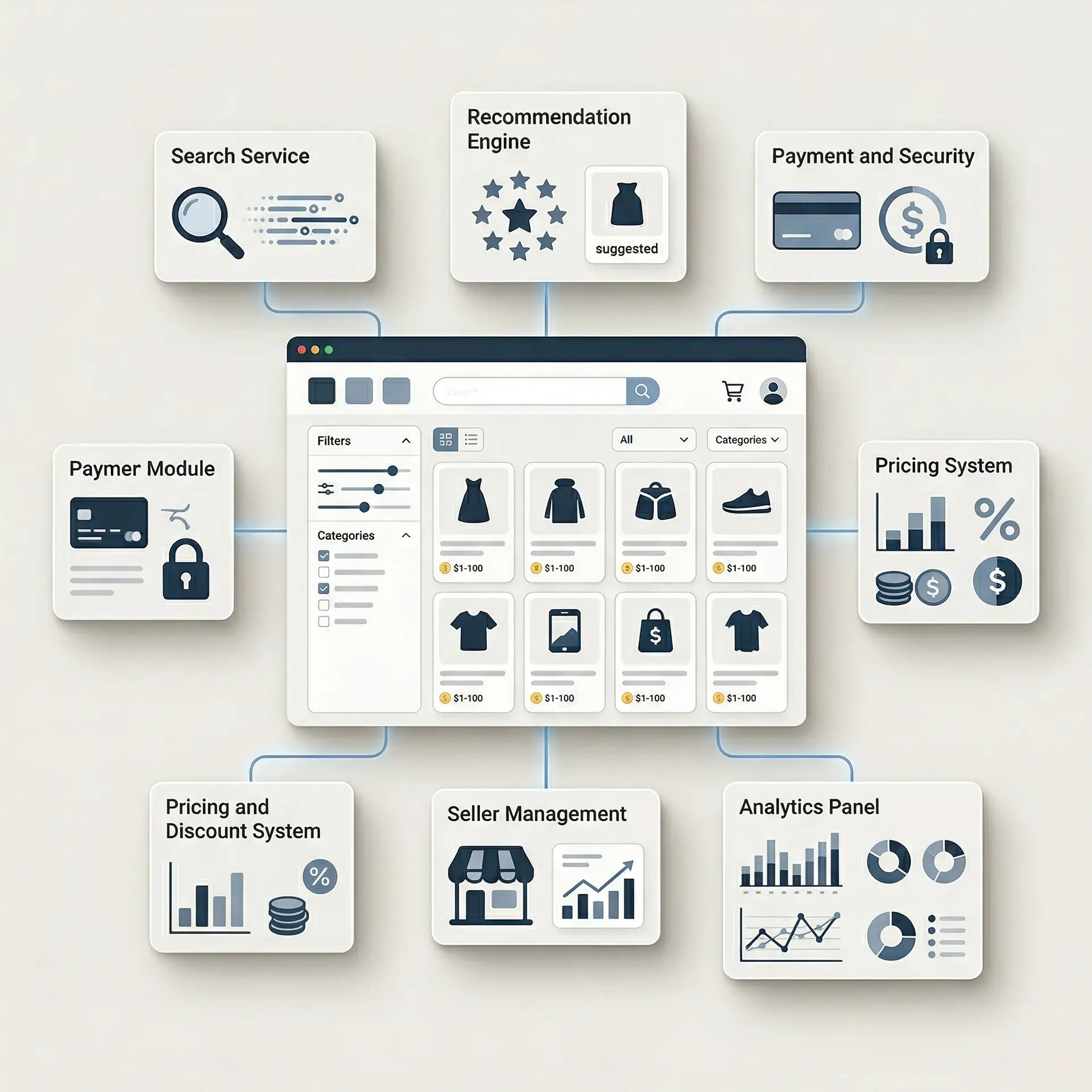
- modular services (search, payments, recommendations, pricing)
- API-first communication between components
- the ability to replace or upgrade individual elements without rebuilding the entire platform
This approach aligns with the broader shift toward MACH architecture (Microservices, API-first, Cloud-native, Headless).
From Monolith to Modular: The Key Differences
Monolithic Marketplace
- tightly coupled systems
- slow deployment cycles
- limited flexibility
- high risk when introducing changes
Composable Marketplace
- independent services
- rapid iteration and deployment
- easy integration with external tools
- lower risk when scaling or modifying features
In a composable model, the marketplace becomes a platform of capabilities, not a single system.
Core Building Blocks of a Composable Marketplace
A well-designed composable marketplace typically includes:
1. Search & Discovery Service
Handles indexing, filtering, and increasingly AI-driven intent recognition.
2. Recommendation Engine
Personalizes user experience through behavioral and contextual data.
3. Pricing & Promotion Module
Supports dynamic pricing, bundles, and campaign logic.
4. Transaction & Payment Layer
Manages checkout flows, payments, and financial operations.
5. Seller Management System
Onboarding, performance tracking, and supply-side tools.
6. Data & Analytics Layer
Centralizes data flow and enables real-time insights and AI integration.
Each component can be developed or replaced independently — without disrupting the entire ecosystem.
Why Composable Architecture Matters for Marketplaces
Speed of Innovation
New features can be deployed without reworking the entire platform.
Flexibility
Easily adapt to new business models, verticals, or user expectations.
Scalability
Scale individual services based on demand (e.g., search vs. payments).
Vendor Independence
Avoid lock-in by integrating best-of-breed tools instead of relying on a single vendor.
AI Readiness
Composable systems are significantly easier to integrate with AI models and real-time data pipelines.
The Role of AI in Composable Marketplaces
Composable architecture and AI are highly complementary.
AI requires:
- continuous data flow
- real-time processing
- the ability to experiment and iterate
A modular system makes it possible to:
- plug in new recommendation engines
- test different ranking algorithms
- deploy predictive pricing models
- integrate external AI services
Without composability, AI becomes difficult to scale and maintain.
Real-World Use Cases
Multi-Vertical Marketplaces
Platforms expanding across categories (e.g., from electronics to services) need flexible architecture to support different logic per vertical.
B2B Platforms
Complex workflows such as RFQs, negotiations, and contract pricing require modular systems.
Rapid Growth Startups
Companies that iterate quickly benefit from being able to swap components without rebuilding infrastructure.
Enterprise Transformations
Large organizations migrating from legacy systems can adopt composable layers gradually instead of full rewrites.
Challenges and Considerations
Integration Complexity
More components mean more APIs and coordination.
Governance
Clear ownership of services is required to avoid fragmentation.
Data Consistency
Ensuring synchronization across services is critical.
Operational Overhead
Requires mature DevOps practices and monitoring systems.
Composable architecture is powerful — but demands discipline and strong technical foundations.
The Future: Marketplace as a Platform Ecosystem
Composable marketplaces are not just more flexible — they redefine what a marketplace is.
Instead of a single product, the marketplace becomes:
- a platform for continuous innovation
- an ecosystem of services and integrations
- a foundation for AI-driven optimization
- a system that evolves without full rebuilds
This enables companies to move faster, experiment more, and respond to market changes in real time.
Conclusion
The shift toward composable marketplaces is not just a technical trend — it is a strategic necessity.
In an environment where:
- user expectations evolve rapidly
- AI capabilities are expanding
- competition is increasing
platforms must be built for change, not stability.
Composable architecture provides that foundation.
Marketplaces that embrace modularity will not only scale more effectively —
they will be able to adapt, innovate, and lead in a continuously evolving digital economy.
Przeglądaj inne artykuły

Why Most Marketplaces Fail: The Hidden Challenges Behind Scaling Supply and Demand

The New Marketplace Economy: How Platforms Are Evolving into Intelligent, Scalable Ecosystems

From Search to Intent: How AI Is Rewriting Marketplace Discovery

AI-Driven Marketplaces: Real-Time Offer Matching as a Competitive Advantage

Category Depth vs Category Breadth: The Real Economics Behind Marketplace Expansion

Liquidity Is Not Volume: The Structural Mistake That Kills Marketplaces

The Take Rate Trap: Why Raising Commissions Is the Fastest Way to Kill a Marketplace

When to Fire Sellers: Why the Best Marketplaces Grow Faster by Shrinking Supply

Marketplace Support Costs: The Hidden Margin Killer No One Models

Tiered Pricing Without Backlash: How to Monetize Sellers Without Killing Growth

Seller Segmentation: The Missing System Behind Profitable Marketplaces

Why Most Marketplaces Die at €1–3M GMV (And How to Avoid It)
Marketplace Unit Economics: When Growth Actually Becomes Profitable

How High-Margin Marketplaces Actually Make Money (Beyond Commissions)

Algorithmic Middle Management: How Software Replaces Control Layers

The Rise of Internal Software: Why the Most Profitable Digital Products Are Built for Companies, Not

Decision-Centric Software: Why the Real Value of Digital Products Is Shifting from Features to Decis

Software That Never Launches: Why Continuous Evolution Is Replacing Releases and Roadmaps

Digital Products Without Users: When Software Works Entirely Machine-to-Machine
Unbundled Platforms: Why the Future of Digital Products Belongs to Ecosystems, Not Single Applicatio

Silent Software: Why the Most Valuable Digital Products of the Future Will Be the Ones Users Barely

Cognitive Commerce: How AI Learns to Think Like Your Customers and Redefines Digital Shopping

Predictive UX: How AI Anticipates User Behavior Before It Happens

AI-Driven Product Innovation: How Intelligent Systems Are Transforming the Way Digital Products Are

Adaptive Commerce: How AI-Driven Systems Automatically Optimize Online Stores in Real Time

Zero-UI Commerce: How Invisible Interfaces Are Becoming the Future of Online Shopping

AI Merchandising: How Intelligent Algorithms Are Transforming Product Discovery in Modern E-Commerce

Composable Commerce: How Modular Architecture Is Reshaping Modern E-Commerce and Marketplace Develop

Context-Aware Software: How Apps Are Becoming Smarter, Adaptive, and Environment-Responsive

AI-Driven Observability: The New Backbone of Modern Software Systems

Hyper-Personalized Software: How AI Is Creating Products That Adapt Themselves to Every User

Edge Intelligence: The Future of Smart, Decentralized Computing

AI-Powered Cybersecurity: How Intelligent Systems Are Redefining Digital Defense

Modern Software: How Our Company Is Reshaping the Technology Landscape

From Digital Transformation to Digital Maturity: Building the Next Generation of Tech-Driven Busines

AI Agents: The Rise of Autonomous Digital Workers in Business and Software Engineering

Synthetic Data: The Next Frontier of AI and Business Intelligence

Quantum AI: How Quantum Computing Will Redefine Artificial Intelligence and Software Engineering

Design Intelligence: How AI Is Redefining UX/UI and Digital Product Creativity

How Artificial Intelligence Is Transforming DevOps and IT Infrastructure

AI Observability in Production: Monitoring, Anomaly Detection, and Feedback Loops for Smart Applicat

Low-Code Revolution: How Visual Development Is Transforming Software and Marketplace Creation

Composable Marketplaces: How Modular Architecture Is the Future of Platform Engineering

AI-Powered Storyselling: How Artificial Intelligence Is Reinventing Brand Narratives

The Era of Invisible Commerce: How AI Will Make Shopping Disappear by 2030

From Attention to Intention: The New Era of E-Commerce Engagement

Predictive Commerce: How AI Can Anticipate What Your Customers Will Buy Next

Digital Trust 2030: How AI and Cybersecurity Will Redefine Safety in the Digital Age

Cybersecurity in the Age of AI: Protecting Digital Trust in 2025–2030

The Future of Work: Humans and AI as Teammates

Green IT: How the Tech Industry Must Adapt for a Sustainable Future

Emerging Technologies in IT: What Will Shape 2025–2030

Growth Marketing – A Fast-Track Strategy for Modern Businesses

AI SEO Tools – 5 Technologies Revolutionizing Online Stores

AI SEO – How Artificial Intelligence Is Transforming Online Store Optimization

Product-Led Growth – When the Product Sells Itself

Technology in IT – Trends Shaping the Future of Business and Everyday Life

Marketplace Growth – How Exchange Platforms and E-commerce Build the Network Effect

Edge Computing – Bringing Processing Power Closer to the User

Agentic AI in Applications – When Software Starts Acting on Its Own

Neuromorphic Computers and 6G Networks – The Future of IT That Will Change the Game

Meta Llama 3.2 – The Open AI That Could Transform E-Commerce and SEO

AI Chatbot for Online Stores and Apps – More Sales, Better SEO, and Happier Customers

5 steps to a successful software implementation in your company

Innovative IT solutions — why invest now?

Innovative software development methods for your business

5 steps to successfully implement technological innovation in your company