
How High-Margin Marketplaces Actually Make Money (Beyond Commissions)
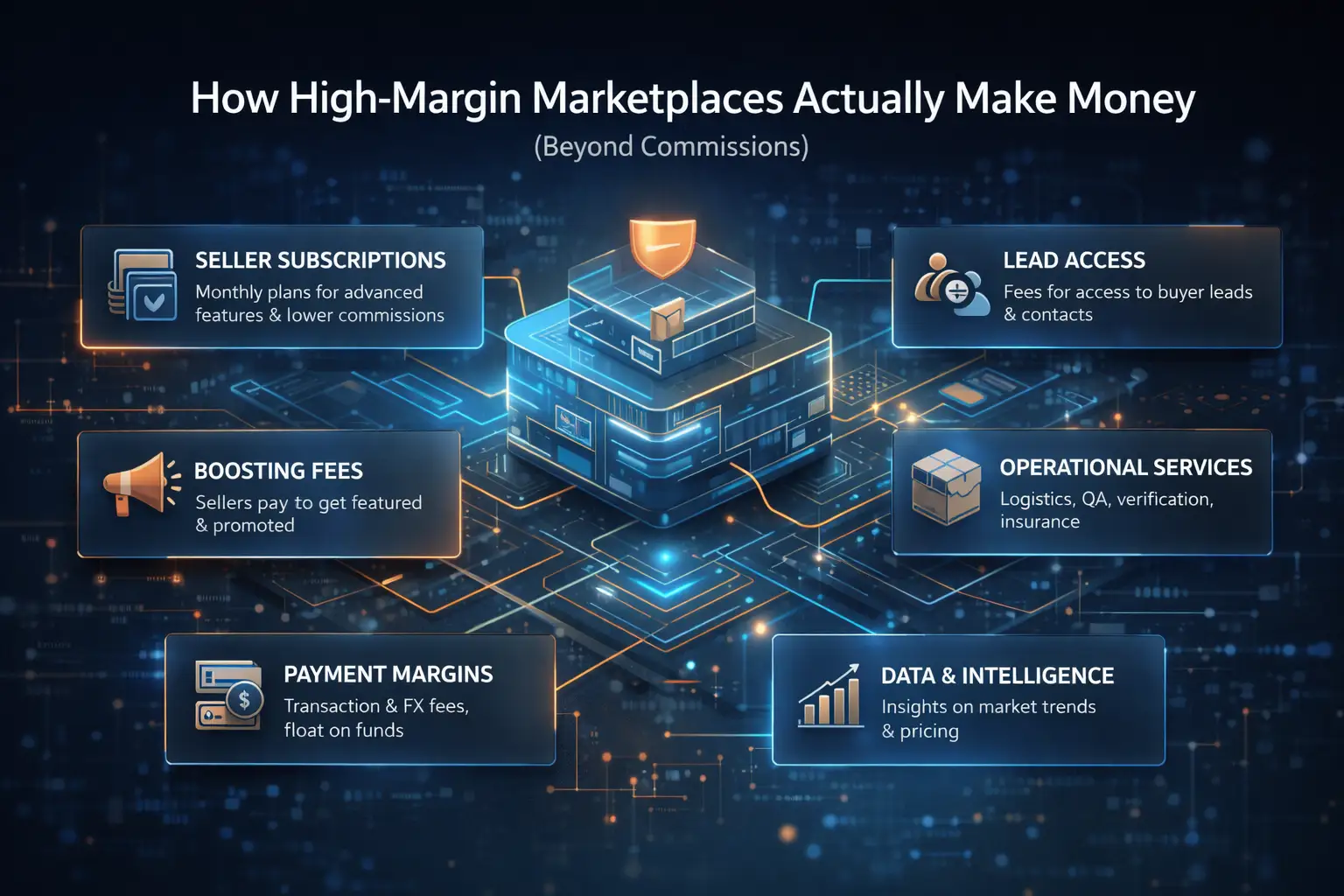
How High-Margin Marketplaces Actually Make Money (Beyond Commissions)
1. The Commission Myth
The default marketplace model looks simple:
- Sellers list products or services
- Buyers transact
- Platform takes a commission (usually 5–20%)
This model works — but it does not scale profitably on its own.
Why?
Because commissions:
- are easy to compare,
- are constantly under price pressure,
- become a negotiation point with top sellers,
- and rarely exceed 20% in competitive markets.
In mature marketplaces, commissions typically account for 30–50% of total revenue, not 100%.
The rest comes from secondary and tertiary revenue layers.
2. Revenue Layer #1: Listing & Visibility Fees (Low Friction, High Margin)
What it is
Sellers pay for:
- featured listings
- boosted visibility
- priority placement
- category highlights
Typical numbers
- €10–€200 per listing boost
- recurring monthly packages: €50–€500
Why it works
- Zero marginal cost
- Paid by sellers, not buyers
- Directly tied to seller revenue perception
Margin profile
- 80–95% gross margin
Key insight
This revenue stream scales with competition, not with traffic.
The more sellers fight for attention, the more valuable visibility becomes.
3. Revenue Layer #2: Seller Subscriptions (Predictable Cash Flow)
What it is
Monthly plans for sellers that unlock:
- advanced analytics
- higher limits
- API access
- lower commissions
- bulk operations
Typical pricing
- Basic: €29–€49/month
- Pro: €99–€199/month
- Enterprise: €300–€1,000+/month
Why it works
- Recurring revenue
- Sellers anchor on monthly cost, not ROI
- Reduces churn dramatically
Margin profile
- 70–90% gross margin
Reality check
In strong B2B marketplaces, subscriptions alone can cover all platform operating costs.
Everything else becomes profit.
4. Revenue Layer #3: Payments & Financial Float (The Silent Giant)
What it is
Marketplace controls:
- payment processing
- payout timing
- escrow
- currency conversion
Where money is made
- payment processing margin (0.3–1.0%)
- FX spread (0.5–2.0%)
- delayed payouts (interest / float)
Typical impact
On large GMV platforms:
- financial layer = 20–40% of total profit
Why this is powerful
- Invisible to users
- Extremely difficult to replace
- Grows automatically with GMV
Strategic insight
The moment a marketplace controls payments, it stops being “just a platform” and becomes financial infrastructure.
5. Revenue Layer #4: Lead Ownership & Access Fees
What it is
Sellers pay for:
- access to buyer leads
- contact details
- bidding rights
- response priority
Common in:
- services marketplaces
- B2B platforms
- real estate
- logistics
Pricing models
- Pay per lead: €5–€50
- Monthly access: €100–€1,000
- Credit-based systems
Margin profile
- 85–95% gross margin
Important
This model works best when:
- supply > demand
- response time matters
- buyers are not price-sensitive
6. Revenue Layer #5: Data & Market Intelligence
What it is
Aggregated, anonymized insights such as:
- pricing benchmarks
- demand forecasting
- category performance
- competitor positioning
Who pays
- enterprise sellers
- brands
- manufacturers
- investors
Pricing
- €200–€2,000/month
- custom reports: €5k–€50k
Margin profile
- 90%+ gross margin
Hard truth
Data products are often more profitable than the marketplace itself.
But only if data quality is high and trust is established.
7. Revenue Layer #6: Operational Services (Logistics, QA, Compliance)
What it is
Marketplace offers optional services:
- fulfillment
- quality control
- verification
- insurance
- compliance handling
Typical margin
- 10–30% markup on third-party services
Why it matters
- Sticky revenue
- Deep seller lock-in
- Hard for competitors to replicate
Strategic value
Operational services turn the marketplace into part of the seller’s business, not just a channel.
8. Revenue Layer #7: Vendor Financing & Advance Payments
What it is
Marketplace provides:
- early payouts
- invoice financing
- seller advances
How money is made
- 1–4% fee per advance
- dynamic risk pricing
Who can do this
Only marketplaces that:
- control transaction data
- understand seller performance
- manage risk algorithmically
Margin profile
- Very high, but risk-sensitive
This is where marketplaces quietly start behaving like fintechs.
9. Why Most Marketplaces Never Reach High Margins
Common mistakes:
- relying only on commissions
- launching monetization too late
- being afraid to charge sellers
- no control over payments
- no internal analytics layer
- poor seller segmentation
Most failures are economic, not technical.
10. The Real High-Margin Marketplace Formula
High-margin marketplaces share one trait:
They monetize sellers in multiple ways, while buyers experience the platform as “free”.
Typical revenue mix in mature platforms:
- 30–40% commissions
- 20–30% subscriptions
- 10–20% payments & finance
- 10–15% visibility & leads
- 5–10% data & services
This diversification is what creates resilience and profitability.
11. Conclusion
Commissions are just the entry point.
The most profitable marketplaces are not those with the highest traffic —
but those that control attention, payments, data, and operations.
If you are building or scaling a marketplace, the critical question is not:
“What commission should we charge?”
But:
“Which revenue layers do we own — and which are we leaving on the table?”
Przeglądaj inne artykuły

Why Most Marketplaces Fail: The Hidden Challenges Behind Scaling Supply and Demand
Composable Marketplaces: Building Flexible, Scalable Platforms for Modern Commerce

The New Marketplace Economy: How Platforms Are Evolving into Intelligent, Scalable Ecosystems

From Search to Intent: How AI Is Rewriting Marketplace Discovery

AI-Driven Marketplaces: Real-Time Offer Matching as a Competitive Advantage

Category Depth vs Category Breadth: The Real Economics Behind Marketplace Expansion

Liquidity Is Not Volume: The Structural Mistake That Kills Marketplaces

The Take Rate Trap: Why Raising Commissions Is the Fastest Way to Kill a Marketplace

When to Fire Sellers: Why the Best Marketplaces Grow Faster by Shrinking Supply

Marketplace Support Costs: The Hidden Margin Killer No One Models

Tiered Pricing Without Backlash: How to Monetize Sellers Without Killing Growth

Seller Segmentation: The Missing System Behind Profitable Marketplaces

Why Most Marketplaces Die at €1–3M GMV (And How to Avoid It)
Marketplace Unit Economics: When Growth Actually Becomes Profitable

Algorithmic Middle Management: How Software Replaces Control Layers

The Rise of Internal Software: Why the Most Profitable Digital Products Are Built for Companies, Not

Decision-Centric Software: Why the Real Value of Digital Products Is Shifting from Features to Decis

Software That Never Launches: Why Continuous Evolution Is Replacing Releases and Roadmaps

Digital Products Without Users: When Software Works Entirely Machine-to-Machine
Unbundled Platforms: Why the Future of Digital Products Belongs to Ecosystems, Not Single Applicatio

Silent Software: Why the Most Valuable Digital Products of the Future Will Be the Ones Users Barely

Cognitive Commerce: How AI Learns to Think Like Your Customers and Redefines Digital Shopping

Predictive UX: How AI Anticipates User Behavior Before It Happens

AI-Driven Product Innovation: How Intelligent Systems Are Transforming the Way Digital Products Are

Adaptive Commerce: How AI-Driven Systems Automatically Optimize Online Stores in Real Time

Zero-UI Commerce: How Invisible Interfaces Are Becoming the Future of Online Shopping

AI Merchandising: How Intelligent Algorithms Are Transforming Product Discovery in Modern E-Commerce

Composable Commerce: How Modular Architecture Is Reshaping Modern E-Commerce and Marketplace Develop

Context-Aware Software: How Apps Are Becoming Smarter, Adaptive, and Environment-Responsive

AI-Driven Observability: The New Backbone of Modern Software Systems

Hyper-Personalized Software: How AI Is Creating Products That Adapt Themselves to Every User

Edge Intelligence: The Future of Smart, Decentralized Computing

AI-Powered Cybersecurity: How Intelligent Systems Are Redefining Digital Defense

Modern Software: How Our Company Is Reshaping the Technology Landscape

From Digital Transformation to Digital Maturity: Building the Next Generation of Tech-Driven Busines

AI Agents: The Rise of Autonomous Digital Workers in Business and Software Engineering

Synthetic Data: The Next Frontier of AI and Business Intelligence

Quantum AI: How Quantum Computing Will Redefine Artificial Intelligence and Software Engineering

Design Intelligence: How AI Is Redefining UX/UI and Digital Product Creativity

How Artificial Intelligence Is Transforming DevOps and IT Infrastructure

AI Observability in Production: Monitoring, Anomaly Detection, and Feedback Loops for Smart Applicat

Low-Code Revolution: How Visual Development Is Transforming Software and Marketplace Creation

Composable Marketplaces: How Modular Architecture Is the Future of Platform Engineering

AI-Powered Storyselling: How Artificial Intelligence Is Reinventing Brand Narratives

The Era of Invisible Commerce: How AI Will Make Shopping Disappear by 2030

From Attention to Intention: The New Era of E-Commerce Engagement

Predictive Commerce: How AI Can Anticipate What Your Customers Will Buy Next

Digital Trust 2030: How AI and Cybersecurity Will Redefine Safety in the Digital Age

Cybersecurity in the Age of AI: Protecting Digital Trust in 2025–2030

The Future of Work: Humans and AI as Teammates

Green IT: How the Tech Industry Must Adapt for a Sustainable Future

Emerging Technologies in IT: What Will Shape 2025–2030

Growth Marketing – A Fast-Track Strategy for Modern Businesses

AI SEO Tools – 5 Technologies Revolutionizing Online Stores

AI SEO – How Artificial Intelligence Is Transforming Online Store Optimization

Product-Led Growth – When the Product Sells Itself

Technology in IT – Trends Shaping the Future of Business and Everyday Life

Marketplace Growth – How Exchange Platforms and E-commerce Build the Network Effect

Edge Computing – Bringing Processing Power Closer to the User

Agentic AI in Applications – When Software Starts Acting on Its Own

Neuromorphic Computers and 6G Networks – The Future of IT That Will Change the Game

Meta Llama 3.2 – The Open AI That Could Transform E-Commerce and SEO

AI Chatbot for Online Stores and Apps – More Sales, Better SEO, and Happier Customers

5 steps to a successful software implementation in your company

Innovative IT solutions — why invest now?

Innovative software development methods for your business

5 steps to successfully implement technological innovation in your company