
Marketplace Unit Economics: When Growth Actually Becomes Profitable
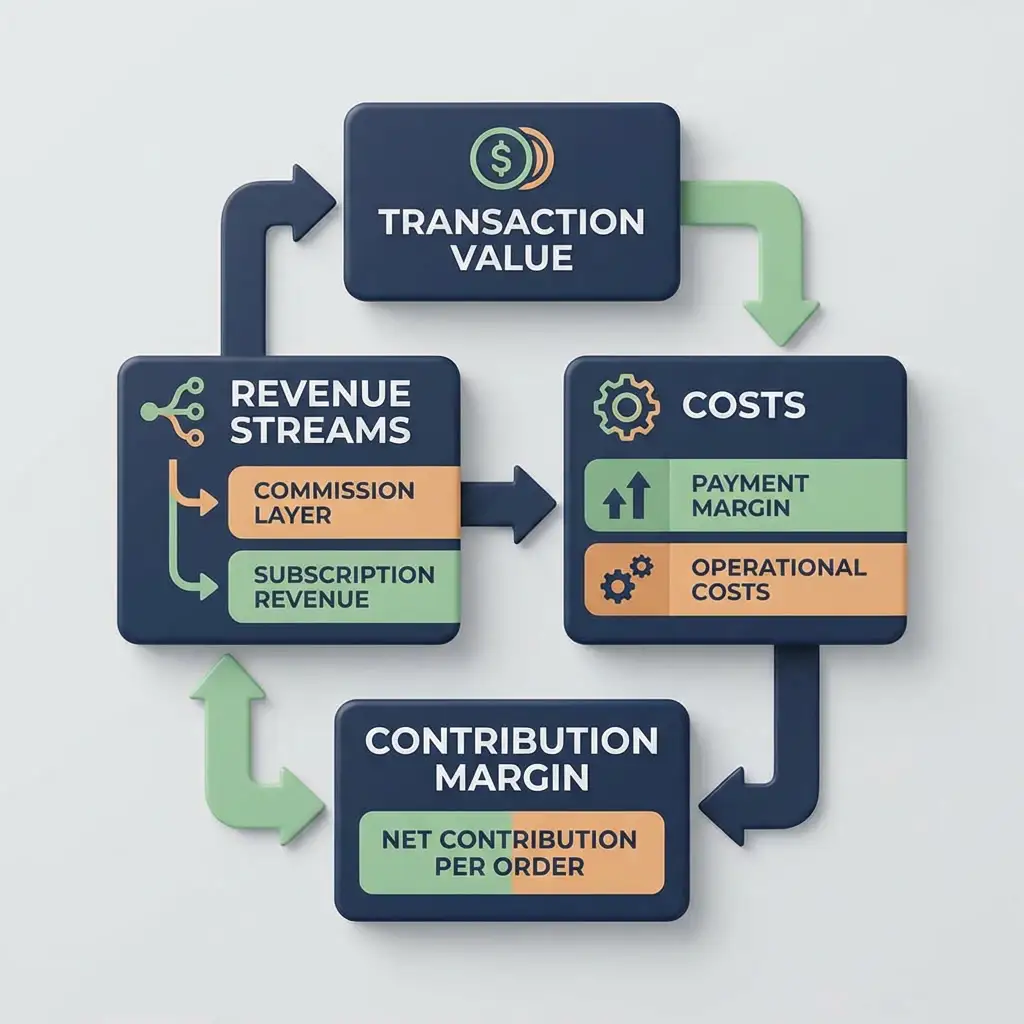
Marketplace Unit Economics: When Growth Actually Becomes Profitable
1. Growth Is Not the Same as Profitability
One of the most common mistakes marketplace founders make is assuming that scale automatically fixes economics.
It doesn’t.
Many platforms grow GMV year over year while:
- margins stay flat,
- costs grow faster than revenue,
- operational complexity explodes,
- and profitability keeps moving further away.
The key question is not:
“How fast are we growing?”
But:
“Are we making money on every transaction — and if not, why?”
That question lives inside unit economics.
2. What Unit Economics Means in a Marketplace Context
Unit economics answers one simple question:
Does a single transaction create value — or destroy it?
For marketplaces, the “unit” is usually:
- one transaction, or
- one active seller per month, or
- one fulfilled order.
At minimum, you must understand:
Revenue per unit – Cost per unit = Contribution margin
If this number is negative, scaling only accelerates losses.
3. Core Revenue per Transaction (What Actually Comes In)
Typical revenue components per order:
- Commission
- 5–20% of order value
- Payment margin
- 0.3–1.0%
- Seller subscription allocation
- monthly fee divided by orders
- Visibility / lead fees (if applicable)
Example
Order value: €100
- Commission (10%): €10
- Payment margin (0.5%): €0.50
- Subscription allocation: €1.00
Total revenue per order: €11.50
This is the maximum you can work with.
4. Real Cost per Transaction (Often Underestimated)
Founders usually underestimate costs.
Typical per-order costs include:
- Payment processing
- 1.5–3.0% (€1.50–€3.00)
- Customer support
- €0.50–€2.00 per order (tickets, disputes)
- Infrastructure & tooling
- €0.20–€1.00 (hosting, monitoring, APIs)
- Operations & QA (if involved)
- €1.00–€5.00
- Fraud, refunds, disputes
- 0.5–2% of GMV
Conservative example
Total cost per order: €5.00–€7.00
5. Contribution Margin: The Make-or-Break Number
Using earlier example:
Revenue per order: €11.50
Cost per order: €6.00
Contribution margin: €5.50 per order
This margin must cover:
- product development
- sales & marketing
- admin & management
- growth investments
If contribution margin is below €2–€3 per order, profitability becomes very difficult.
6. The Break-Even Illusion at Scale
Many marketplaces assume:
“We’ll fix margins later, once we scale.”
In reality:
- commissions get pressured down,
- top sellers negotiate discounts,
- support costs increase with complexity,
- refunds rise with volume.
Margins often shrink with scale unless actively designed otherwise.
Healthy marketplaces improve unit economics before scaling.
7. Seller-Level Unit Economics (More Important Than Orders)
A more reliable metric than per-order economics is:
Contribution margin per active seller per month
Example
Seller generates:
- 50 orders/month
- €5.50 margin/order
Monthly contribution: €275 per seller
If:
- seller support + tooling cost = €40/month
- seller churn < 3%
This is a strong, scalable base.
High-quality marketplaces optimize for seller profitability first, not raw order volume.
8. When Growth Becomes Profitable (Real Thresholds)
Based on real marketplace data, profitability often starts when:
- Contribution margin ≥ 30–40% of net revenue
- Seller LTV ≥ 5–8× CAC
- Support cost per order ≤ 10–15% of revenue
- At least 2–3 revenue streams active (not only commission)
GMV alone is meaningless without these conditions.
9. Common Unit Economics Killers
The patterns that destroy profitability:
- free or underpriced seller onboarding
- one-size-fits-all commission
- no seller segmentation
- no payment control
- late monetization
- manual operations at scale
- no cost attribution per transaction
Most “growth-stage crises” are actually unit economics problems in disguise.
10. How Profitable Marketplaces Think Differently
They ask:
- Which sellers are actually profitable?
- Which orders lose money?
- Where does margin leak operationally?
- Which costs scale linearly — and which shouldn’t?
- What can be automated at transaction level?
They design economics first — and growth second.
11. Conclusion
Marketplace success is not about traffic, branding, or GMV charts.
It is about:
- positive contribution margins,
- disciplined cost control,
- diversified revenue streams,
- and seller-centric economics.
Growth only becomes profitable after unit economics work — never before.
If you don’t understand your unit economics, your marketplace is not scaling.
It is accelerating risk.
Przeglądaj inne artykuły

Why Most Marketplaces Fail: The Hidden Challenges Behind Scaling Supply and Demand

Composable Marketplaces: Building Flexible, Scalable Platforms for Modern Commerce

The New Marketplace Economy: How Platforms Are Evolving into Intelligent, Scalable Ecosystems

From Search to Intent: How AI Is Rewriting Marketplace Discovery

AI-Driven Marketplaces: Real-Time Offer Matching as a Competitive Advantage

Category Depth vs Category Breadth: The Real Economics Behind Marketplace Expansion

Liquidity Is Not Volume: The Structural Mistake That Kills Marketplaces

The Take Rate Trap: Why Raising Commissions Is the Fastest Way to Kill a Marketplace

When to Fire Sellers: Why the Best Marketplaces Grow Faster by Shrinking Supply

Marketplace Support Costs: The Hidden Margin Killer No One Models

Tiered Pricing Without Backlash: How to Monetize Sellers Without Killing Growth

Seller Segmentation: The Missing System Behind Profitable Marketplaces

Why Most Marketplaces Die at €1–3M GMV (And How to Avoid It)

How High-Margin Marketplaces Actually Make Money (Beyond Commissions)

Algorithmic Middle Management: How Software Replaces Control Layers

The Rise of Internal Software: Why the Most Profitable Digital Products Are Built for Companies, Not

Decision-Centric Software: Why the Real Value of Digital Products Is Shifting from Features to Decis

Software That Never Launches: Why Continuous Evolution Is Replacing Releases and Roadmaps

Digital Products Without Users: When Software Works Entirely Machine-to-Machine

Unbundled Platforms: Why the Future of Digital Products Belongs to Ecosystems, Not Single Applicatio

Silent Software: Why the Most Valuable Digital Products of the Future Will Be the Ones Users Barely

Cognitive Commerce: How AI Learns to Think Like Your Customers and Redefines Digital Shopping

Predictive UX: How AI Anticipates User Behavior Before It Happens

AI-Driven Product Innovation: How Intelligent Systems Are Transforming the Way Digital Products Are

Adaptive Commerce: How AI-Driven Systems Automatically Optimize Online Stores in Real Time

Zero-UI Commerce: How Invisible Interfaces Are Becoming the Future of Online Shopping

AI Merchandising: How Intelligent Algorithms Are Transforming Product Discovery in Modern E-Commerce

Composable Commerce: How Modular Architecture Is Reshaping Modern E-Commerce and Marketplace Develop

Context-Aware Software: How Apps Are Becoming Smarter, Adaptive, and Environment-Responsive

AI-Driven Observability: The New Backbone of Modern Software Systems

Hyper-Personalized Software: How AI Is Creating Products That Adapt Themselves to Every User

Edge Intelligence: The Future of Smart, Decentralized Computing

AI-Powered Cybersecurity: How Intelligent Systems Are Redefining Digital Defense

Modern Software: How Our Company Is Reshaping the Technology Landscape

From Digital Transformation to Digital Maturity: Building the Next Generation of Tech-Driven Busines

AI Agents: The Rise of Autonomous Digital Workers in Business and Software Engineering

Synthetic Data: The Next Frontier of AI and Business Intelligence

Quantum AI: How Quantum Computing Will Redefine Artificial Intelligence and Software Engineering

Design Intelligence: How AI Is Redefining UX/UI and Digital Product Creativity

How Artificial Intelligence Is Transforming DevOps and IT Infrastructure

AI Observability in Production: Monitoring, Anomaly Detection, and Feedback Loops for Smart Applicat

Low-Code Revolution: How Visual Development Is Transforming Software and Marketplace Creation

Composable Marketplaces: How Modular Architecture Is the Future of Platform Engineering

AI-Powered Storyselling: How Artificial Intelligence Is Reinventing Brand Narratives

The Era of Invisible Commerce: How AI Will Make Shopping Disappear by 2030

From Attention to Intention: The New Era of E-Commerce Engagement

Predictive Commerce: How AI Can Anticipate What Your Customers Will Buy Next

Digital Trust 2030: How AI and Cybersecurity Will Redefine Safety in the Digital Age

Cybersecurity in the Age of AI: Protecting Digital Trust in 2025–2030

The Future of Work: Humans and AI as Teammates

Green IT: How the Tech Industry Must Adapt for a Sustainable Future

Emerging Technologies in IT: What Will Shape 2025–2030

Growth Marketing – A Fast-Track Strategy for Modern Businesses

AI SEO Tools – 5 Technologies Revolutionizing Online Stores

AI SEO – How Artificial Intelligence Is Transforming Online Store Optimization

Product-Led Growth – When the Product Sells Itself

Technology in IT – Trends Shaping the Future of Business and Everyday Life

Marketplace Growth – How Exchange Platforms and E-commerce Build the Network Effect

Edge Computing – Bringing Processing Power Closer to the User

Agentic AI in Applications – When Software Starts Acting on Its Own

Neuromorphic Computers and 6G Networks – The Future of IT That Will Change the Game

Meta Llama 3.2 – The Open AI That Could Transform E-Commerce and SEO

AI Chatbot for Online Stores and Apps – More Sales, Better SEO, and Happier Customers

5 steps to a successful software implementation in your company

Innovative IT solutions — why invest now?

Innovative software development methods for your business

5 steps to successfully implement technological innovation in your company