
Algorithmic Middle Management: How Software Replaces Control Layers
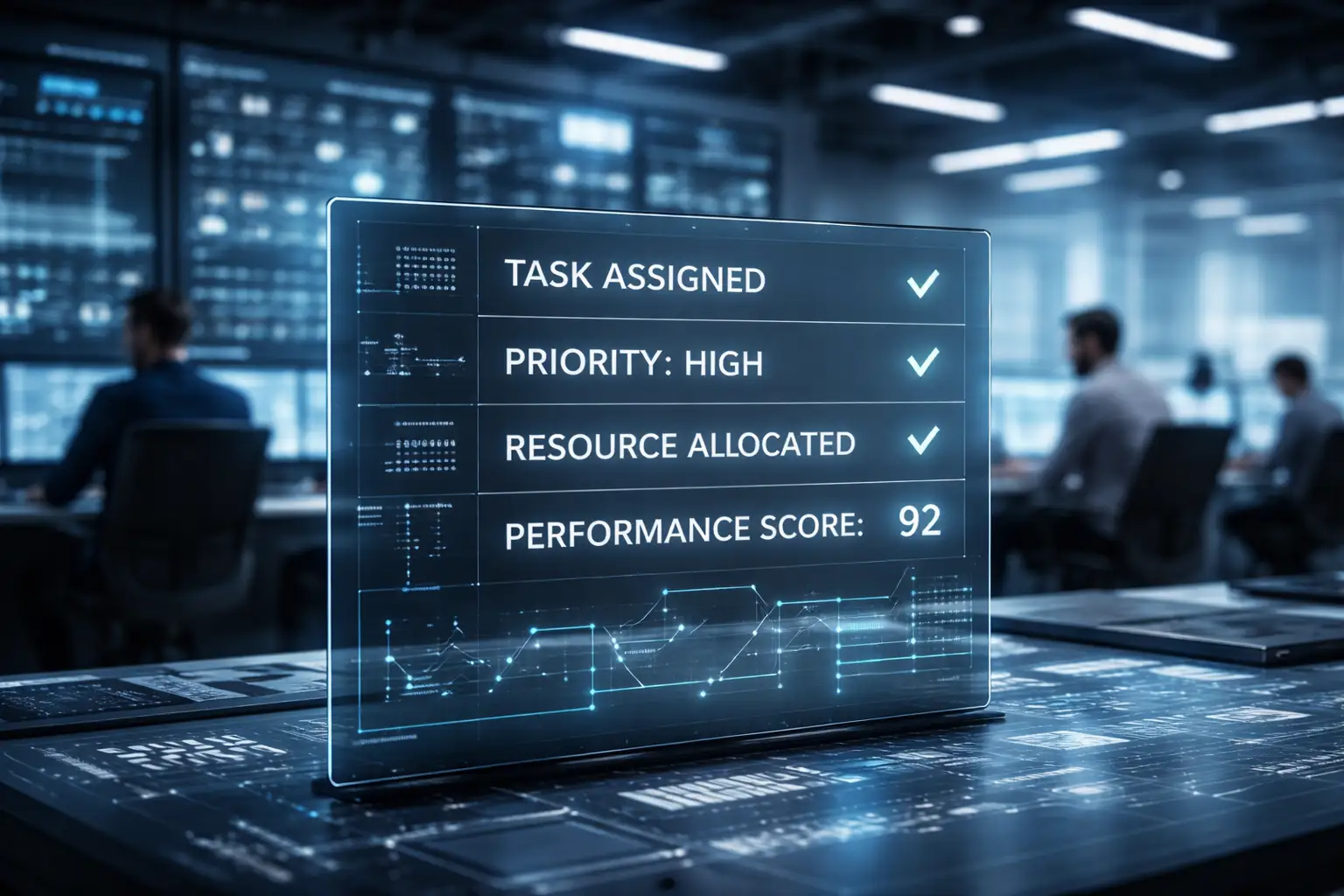
Algorithmic Middle Management: How Software Is Quietly Replacing Entire Layers of Organizational Control
1. Introduction
For decades, organizations scaled in a predictable way.
More people meant more managers.
More managers meant more coordination.
More coordination meant slower decisions.
Middle management existed to translate strategy into execution:
set priorities, monitor performance, resolve conflicts, and enforce rules.
But as digital companies scale globally and operate in real time, this model is breaking down.
Today, a new layer is emerging — not made of people, but of software.
This is the rise of algorithmic middle management.
2. What Is Algorithmic Middle Management?
Algorithmic middle management refers to software systems that perform classic managerial functions without human involvement.
These systems:
- prioritize tasks,
- allocate work,
- enforce policies,
- evaluate performance,
- resolve resource conflicts,
- escalate exceptions.
They don’t motivate.
They don’t coach.
They don’t attend meetings.
They coordinate execution at scale.
3. Why Traditional Middle Management No Longer Scales
Classic management assumes:
- limited data,
- slow feedback loops,
- human judgment as the bottleneck.
Modern organizations face:
- thousands of parallel processes,
- real-time signals,
- global operations,
- continuous change.
In this environment, human coordination becomes:
- too slow,
- too subjective,
- too expensive,
- too inconsistent.
Software, by contrast, can coordinate millions of decisions per second — consistently and without fatigue.
4. Where Algorithmic Management Already Exists
Even if it’s rarely called that, algorithmic management is already widespread.
Work Allocation Systems
Automatically assign tasks based on capacity, priority, and performance.
Performance Scoring Engines
Continuously evaluate output and efficiency.
Policy Enforcement Layers
Ensure rules are followed without human intervention.
Resource Optimization Systems
Decide where time, money, or infrastructure is allocated.
Escalation Engines
Detect anomalies and route issues to humans only when necessary.
In many organizations, these systems quietly replaced entire layers of oversight.
5. How These Systems Are Built
Algorithmic middle management relies on:
A. Rules Engines
Codified policies and constraints.
B. Machine Learning Models
Prediction, classification, and prioritization.
C. Event-Driven Architecture
Real-time reaction to operational signals.
D. Feedback Loops
Continuous improvement based on outcomes.
E. Audit and Override Mechanisms
Human intervention when needed.
The goal is not autonomy for its own sake — but scalable coordination.
6. Business Impact
Companies adopting algorithmic management experience:
Lower Coordination Costs
Fewer meetings, fewer handoffs, fewer approvals.
Faster Execution
Decisions happen instantly, not after alignment calls.
More Consistency
Rules are enforced equally, every time.
Better Scalability
Growth without proportional headcount increases.
Hidden Competitive Advantage
Competitors cannot easily see or copy internal coordination logic.
These benefits compound quietly over time.
7. Organizational Consequences
Algorithmic management changes what humans do.
Managers Become Designers
They design rules, not workflows.
Leadership Focuses on Intent
Strategy defines constraints; software handles execution.
Employees Interact with Systems, Not Supervisors
Feedback becomes immediate and objective.
Organizations Become More Modular
Teams coordinate through systems, not hierarchy.
The structure becomes flatter — but more controlled.
8. Risks and Ethical Considerations
Replacing human judgment with algorithms is not without danger.
Key risks include:
- opaque decision logic,
- loss of empathy,
- over-optimization,
- bias encoded into rules,
- reduced human agency.
Algorithmic management must be:
- explainable,
- auditable,
- adjustable,
- and bounded by clear governance.
Without this, efficiency turns into alienation.
9. The Future: Organizations as Executable Code
We are moving toward companies that operate like software:
- strategy expressed as constraints,
- rules encoded into systems,
- execution automated,
- exceptions escalated selectively.
In this model, management is no longer a layer of people —
it is a layer of logic.
The most effective organizations will not be the ones with the best managers —
but the ones with the best coordination systems.
10. Conclusion
Algorithmic middle management represents a fundamental shift in how organizations operate.
It replaces meetings with signals,
oversight with automation,
and hierarchy with logic.
For digital companies operating at scale, this shift is no longer optional.
The future of management is not human or artificial —
it is architectural.
Przeglądaj inne artykuły
Why Most Marketplaces Fail: The Hidden Challenges Behind Scaling Supply and Demand
Composable Marketplaces: Building Flexible, Scalable Platforms for Modern Commerce

The New Marketplace Economy: How Platforms Are Evolving into Intelligent, Scalable Ecosystems

From Search to Intent: How AI Is Rewriting Marketplace Discovery

AI-Driven Marketplaces: Real-Time Offer Matching as a Competitive Advantage

Category Depth vs Category Breadth: The Real Economics Behind Marketplace Expansion

Liquidity Is Not Volume: The Structural Mistake That Kills Marketplaces

The Take Rate Trap: Why Raising Commissions Is the Fastest Way to Kill a Marketplace

When to Fire Sellers: Why the Best Marketplaces Grow Faster by Shrinking Supply

Marketplace Support Costs: The Hidden Margin Killer No One Models

Tiered Pricing Without Backlash: How to Monetize Sellers Without Killing Growth

Seller Segmentation: The Missing System Behind Profitable Marketplaces

Why Most Marketplaces Die at €1–3M GMV (And How to Avoid It)
Marketplace Unit Economics: When Growth Actually Becomes Profitable
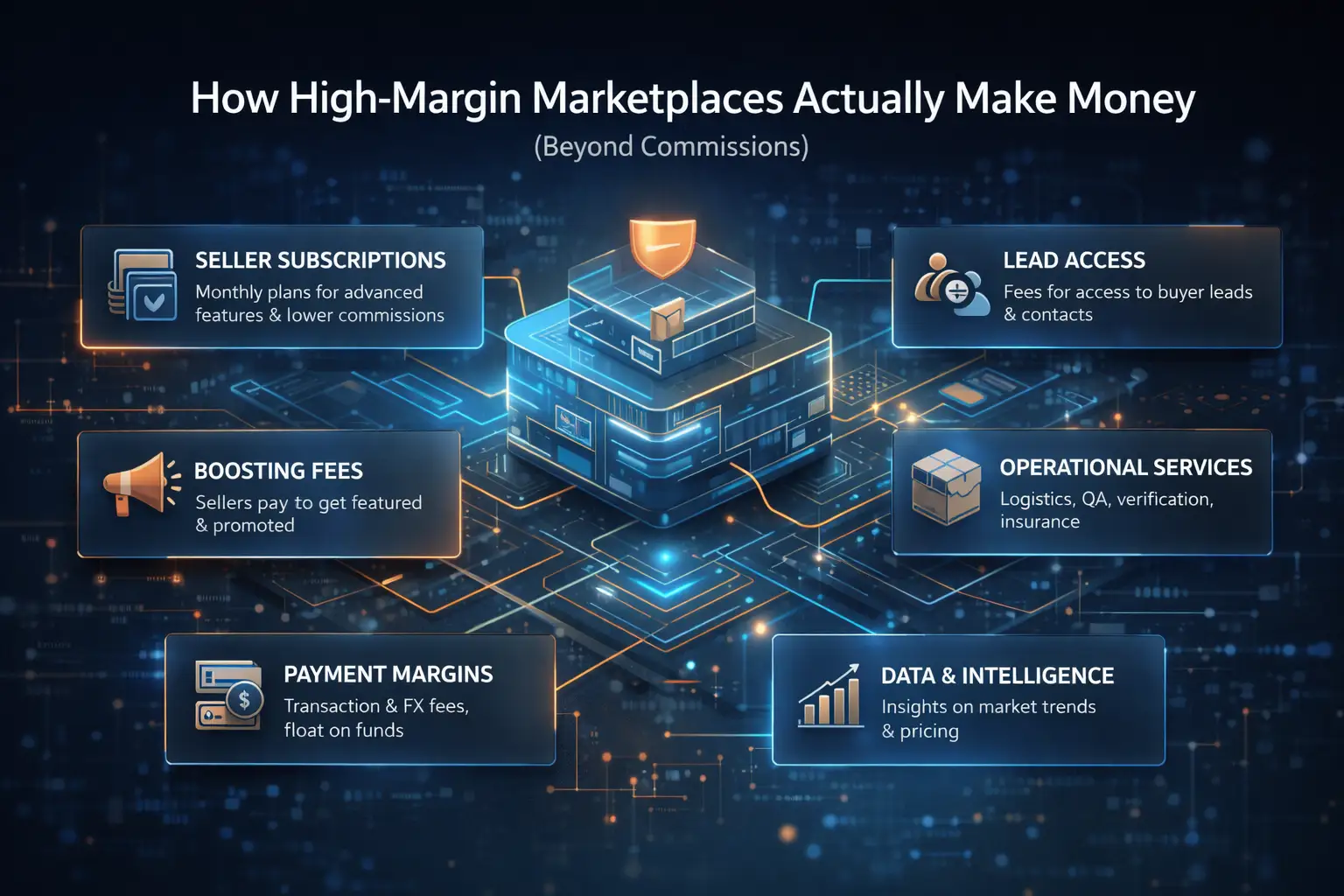
How High-Margin Marketplaces Actually Make Money (Beyond Commissions)

The Rise of Internal Software: Why the Most Profitable Digital Products Are Built for Companies, Not
Decision-Centric Software: Why the Real Value of Digital Products Is Shifting from Features to Decis
Software That Never Launches: Why Continuous Evolution Is Replacing Releases and Roadmaps
Digital Products Without Users: When Software Works Entirely Machine-to-Machine
Unbundled Platforms: Why the Future of Digital Products Belongs to Ecosystems, Not Single Applicatio

Silent Software: Why the Most Valuable Digital Products of the Future Will Be the Ones Users Barely

Cognitive Commerce: How AI Learns to Think Like Your Customers and Redefines Digital Shopping

Predictive UX: How AI Anticipates User Behavior Before It Happens

AI-Driven Product Innovation: How Intelligent Systems Are Transforming the Way Digital Products Are

Adaptive Commerce: How AI-Driven Systems Automatically Optimize Online Stores in Real Time

Zero-UI Commerce: How Invisible Interfaces Are Becoming the Future of Online Shopping

AI Merchandising: How Intelligent Algorithms Are Transforming Product Discovery in Modern E-Commerce
Composable Commerce: How Modular Architecture Is Reshaping Modern E-Commerce and Marketplace Develop

Context-Aware Software: How Apps Are Becoming Smarter, Adaptive, and Environment-Responsive
AI-Driven Observability: The New Backbone of Modern Software Systems

Hyper-Personalized Software: How AI Is Creating Products That Adapt Themselves to Every User

Edge Intelligence: The Future of Smart, Decentralized Computing

AI-Powered Cybersecurity: How Intelligent Systems Are Redefining Digital Defense

Modern Software: How Our Company Is Reshaping the Technology Landscape

From Digital Transformation to Digital Maturity: Building the Next Generation of Tech-Driven Busines

AI Agents: The Rise of Autonomous Digital Workers in Business and Software Engineering

Synthetic Data: The Next Frontier of AI and Business Intelligence

Quantum AI: How Quantum Computing Will Redefine Artificial Intelligence and Software Engineering

Design Intelligence: How AI Is Redefining UX/UI and Digital Product Creativity
How Artificial Intelligence Is Transforming DevOps and IT Infrastructure

AI Observability in Production: Monitoring, Anomaly Detection, and Feedback Loops for Smart Applicat

Low-Code Revolution: How Visual Development Is Transforming Software and Marketplace Creation

Composable Marketplaces: How Modular Architecture Is the Future of Platform Engineering
AI-Powered Storyselling: How Artificial Intelligence Is Reinventing Brand Narratives

The Era of Invisible Commerce: How AI Will Make Shopping Disappear by 2030

From Attention to Intention: The New Era of E-Commerce Engagement
Predictive Commerce: How AI Can Anticipate What Your Customers Will Buy Next

Digital Trust 2030: How AI and Cybersecurity Will Redefine Safety in the Digital Age

Cybersecurity in the Age of AI: Protecting Digital Trust in 2025–2030

The Future of Work: Humans and AI as Teammates

Green IT: How the Tech Industry Must Adapt for a Sustainable Future

Emerging Technologies in IT: What Will Shape 2025–2030

Growth Marketing – A Fast-Track Strategy for Modern Businesses
AI SEO Tools – 5 Technologies Revolutionizing Online Stores
AI SEO – How Artificial Intelligence Is Transforming Online Store Optimization

Product-Led Growth – When the Product Sells Itself

Technology in IT – Trends Shaping the Future of Business and Everyday Life

Marketplace Growth – How Exchange Platforms and E-commerce Build the Network Effect

Edge Computing – Bringing Processing Power Closer to the User

Agentic AI in Applications – When Software Starts Acting on Its Own

Neuromorphic Computers and 6G Networks – The Future of IT That Will Change the Game

Meta Llama 3.2 – The Open AI That Could Transform E-Commerce and SEO

AI Chatbot for Online Stores and Apps – More Sales, Better SEO, and Happier Customers

5 steps to a successful software implementation in your company

Innovative IT solutions — why invest now?

Innovative software development methods for your business

5 steps to successfully implement technological innovation in your company