
Software That Never Launches: Why Continuous Evolution Is Replacing Releases and Roadmaps
Software That Never Launches: Why Continuous Evolution Is Replacing Releases and Roadmaps
1. Introduction
For most of the software industry’s history, progress was visible.
New versions.
Major releases.
Roadmaps stretching months or years into the future.
Big announcements and launch days.
But look closely at today’s most successful digital products — and something feels different.
They don’t really launch anymore.
They don’t have clear “versions.”
They don’t wait for milestones.
They simply change — constantly.
Welcome to the era of software that never launches.
2. The End of the Launch Mentality
Traditional software was shaped by constraints:
- physical distribution,
- long development cycles,
- rigid infrastructure,
- high cost of change.
Releases made sense when updating software was expensive and risky.
Today, those constraints are gone.
Cloud-native infrastructure, feature flags, CI/CD pipelines, and real-time monitoring allow software to change safely and continuously.
In this environment, the concept of a “launch” becomes less relevant — and sometimes meaningless.
3. What Does “Software That Never Launches” Mean?
It doesn’t mean software is unfinished.
It means:
- features appear gradually,
- changes roll out selectively,
- systems adapt dynamically,
- improvements happen invisibly,
- rollback is instant,
- evolution never stops.
Instead of shipping versions, companies ship capabilities — continuously.
The product is never “done,” but it is always current.
4. Why Roadmaps Are Becoming a Liability
Classic roadmaps assume:
- stable requirements,
- predictable markets,
- linear progress.
Modern digital environments offer none of these.
Markets shift weekly.
User behavior changes daily.
Competitors react instantly.
Regulation evolves unexpectedly.
In this reality, long-term roadmaps often lock teams into decisions that no longer make sense by the time they are executed.
Continuous evolution replaces roadmaps with directional intent, not fixed plans.
5. The Technology Enabling Continuous Evolution
This shift is only possible because of major architectural changes:
A. Feature Flags & Progressive Delivery
Features can be enabled, tested, adjusted, or removed instantly.
B. Modular & Composable Architectures
Systems evolve piece by piece, not as a whole.
C. Real-Time Observability
Every change is measured immediately.
D. Automated Testing & Rollbacks
Risk is reduced, not eliminated — but managed continuously.
E. AI-Assisted Decision-Making
Systems suggest when to change, not just how.
Together, these tools turn software into a living system.
6. Business Implications: From Projects to Processes
When software never launches, business thinking must change.
Product Management
Shifts from “what do we ship?” to “what do we optimize next?”
Marketing
Moves away from launch campaigns toward continuous storytelling.
Sales
Sells outcomes and capabilities, not versions.
Customer Expectations
Users stop asking “what’s new?” — they just expect things to improve.
Value is delivered through consistency, not spectacle.
7. Pricing and Monetization in a No-Launch World
Continuous evolution favors new pricing models:
- subscriptions over licenses,
- usage-based pricing over feature tiers,
- outcome-based contracts over deliverables.
When products never launch, customers pay for ongoing value, not access to a static product.
This aligns revenue with evolution — not with milestones.
8. Why This Model Is Hard to Copy
Software that never launches requires:
- strong engineering discipline,
- mature infrastructure,
- cultural acceptance of uncertainty,
- trust in data over opinion,
- comfort with constant change.
Many organizations struggle with this mindset shift — which creates a powerful competitive advantage for those who master it.
9. Risks and Trade-Offs
Continuous evolution is not without danger:
- users may feel disoriented by constant change,
- lack of visible milestones can reduce perceived progress,
- internal alignment becomes harder,
- governance must be stronger, not weaker.
The key is controlled evolution, not chaos.
10. The Future: Software as a Living System
We are moving toward a world where software behaves more like:
- biological systems,
- adaptive networks,
- evolving organisms.
There will be no clear “before” and “after.”
Only current state.
In this world, the most valuable products will not be the ones that launch best —
but the ones that evolve best.
11. Conclusion
The era of software launches is quietly ending.
In its place emerges a new paradigm:
software as a continuously evolving system, shaped by data, context, and real-world use.
Companies that cling to release-centric thinking will struggle to keep pace.
Those that embrace continuous evolution will build products that feel perpetually modern — without ever launching again.
Przeglądaj inne artykuły
Why Most Marketplaces Fail: The Hidden Challenges Behind Scaling Supply and Demand
Composable Marketplaces: Building Flexible, Scalable Platforms for Modern Commerce

The New Marketplace Economy: How Platforms Are Evolving into Intelligent, Scalable Ecosystems

From Search to Intent: How AI Is Rewriting Marketplace Discovery

AI-Driven Marketplaces: Real-Time Offer Matching as a Competitive Advantage

Category Depth vs Category Breadth: The Real Economics Behind Marketplace Expansion

Liquidity Is Not Volume: The Structural Mistake That Kills Marketplaces

The Take Rate Trap: Why Raising Commissions Is the Fastest Way to Kill a Marketplace

When to Fire Sellers: Why the Best Marketplaces Grow Faster by Shrinking Supply

Marketplace Support Costs: The Hidden Margin Killer No One Models

Tiered Pricing Without Backlash: How to Monetize Sellers Without Killing Growth

Seller Segmentation: The Missing System Behind Profitable Marketplaces

Why Most Marketplaces Die at €1–3M GMV (And How to Avoid It)
Marketplace Unit Economics: When Growth Actually Becomes Profitable
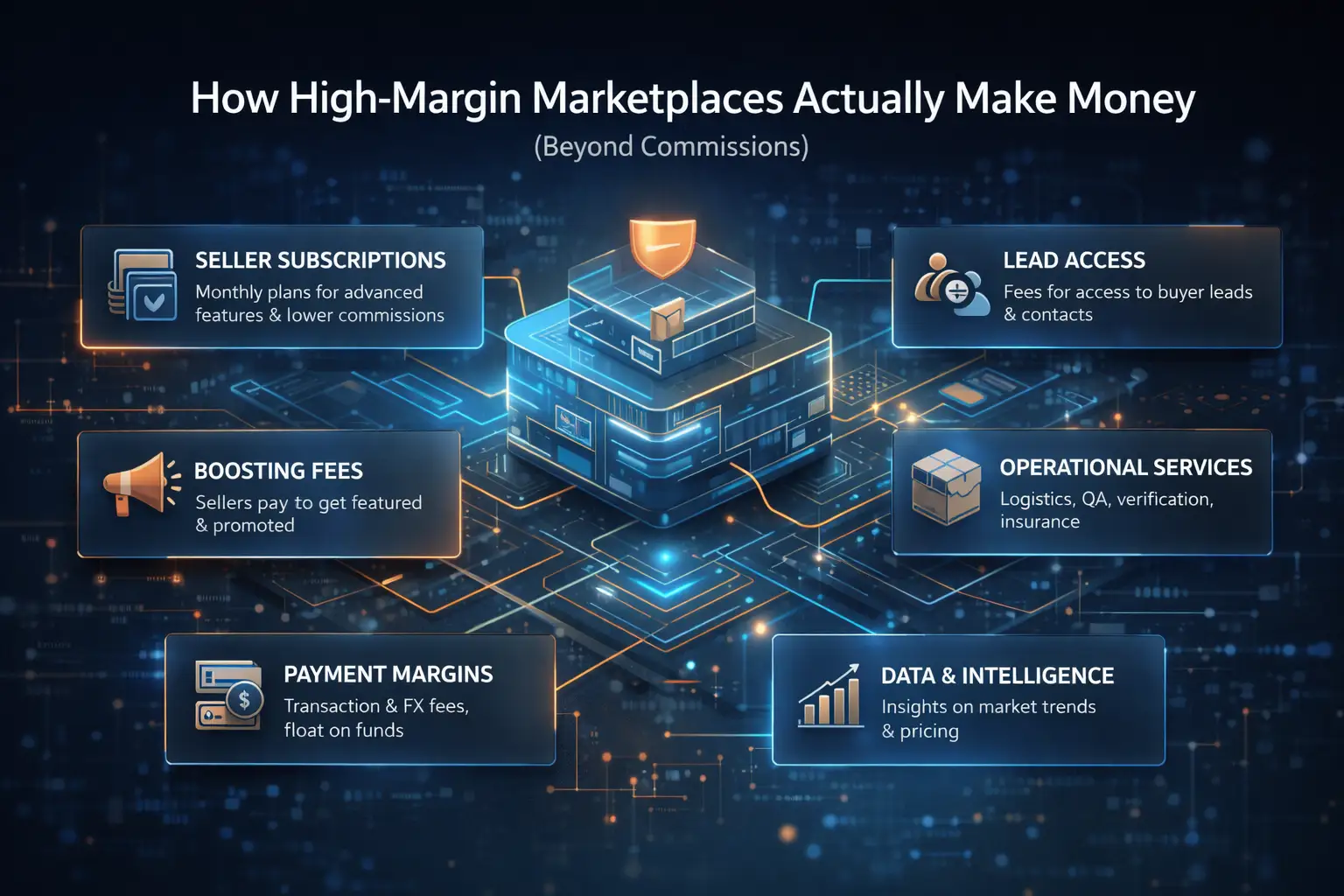
How High-Margin Marketplaces Actually Make Money (Beyond Commissions)

Algorithmic Middle Management: How Software Replaces Control Layers
The Rise of Internal Software: Why the Most Profitable Digital Products Are Built for Companies, Not
Decision-Centric Software: Why the Real Value of Digital Products Is Shifting from Features to Decis
Digital Products Without Users: When Software Works Entirely Machine-to-Machine
Unbundled Platforms: Why the Future of Digital Products Belongs to Ecosystems, Not Single Applicatio
Silent Software: Why the Most Valuable Digital Products of the Future Will Be the Ones Users Barely

Cognitive Commerce: How AI Learns to Think Like Your Customers and Redefines Digital Shopping

Predictive UX: How AI Anticipates User Behavior Before It Happens

AI-Driven Product Innovation: How Intelligent Systems Are Transforming the Way Digital Products Are

Adaptive Commerce: How AI-Driven Systems Automatically Optimize Online Stores in Real Time

Zero-UI Commerce: How Invisible Interfaces Are Becoming the Future of Online Shopping

AI Merchandising: How Intelligent Algorithms Are Transforming Product Discovery in Modern E-Commerce
Composable Commerce: How Modular Architecture Is Reshaping Modern E-Commerce and Marketplace Develop

Context-Aware Software: How Apps Are Becoming Smarter, Adaptive, and Environment-Responsive

AI-Driven Observability: The New Backbone of Modern Software Systems

Hyper-Personalized Software: How AI Is Creating Products That Adapt Themselves to Every User

Edge Intelligence: The Future of Smart, Decentralized Computing

AI-Powered Cybersecurity: How Intelligent Systems Are Redefining Digital Defense

Modern Software: How Our Company Is Reshaping the Technology Landscape

From Digital Transformation to Digital Maturity: Building the Next Generation of Tech-Driven Busines

AI Agents: The Rise of Autonomous Digital Workers in Business and Software Engineering

Synthetic Data: The Next Frontier of AI and Business Intelligence

Quantum AI: How Quantum Computing Will Redefine Artificial Intelligence and Software Engineering

Design Intelligence: How AI Is Redefining UX/UI and Digital Product Creativity

How Artificial Intelligence Is Transforming DevOps and IT Infrastructure

AI Observability in Production: Monitoring, Anomaly Detection, and Feedback Loops for Smart Applicat

Low-Code Revolution: How Visual Development Is Transforming Software and Marketplace Creation

Composable Marketplaces: How Modular Architecture Is the Future of Platform Engineering

AI-Powered Storyselling: How Artificial Intelligence Is Reinventing Brand Narratives

The Era of Invisible Commerce: How AI Will Make Shopping Disappear by 2030

From Attention to Intention: The New Era of E-Commerce Engagement

Predictive Commerce: How AI Can Anticipate What Your Customers Will Buy Next

Digital Trust 2030: How AI and Cybersecurity Will Redefine Safety in the Digital Age

Cybersecurity in the Age of AI: Protecting Digital Trust in 2025–2030

The Future of Work: Humans and AI as Teammates

Green IT: How the Tech Industry Must Adapt for a Sustainable Future

Emerging Technologies in IT: What Will Shape 2025–2030

Growth Marketing – A Fast-Track Strategy for Modern Businesses

AI SEO Tools – 5 Technologies Revolutionizing Online Stores
AI SEO – How Artificial Intelligence Is Transforming Online Store Optimization

Product-Led Growth – When the Product Sells Itself

Technology in IT – Trends Shaping the Future of Business and Everyday Life

Marketplace Growth – How Exchange Platforms and E-commerce Build the Network Effect

Edge Computing – Bringing Processing Power Closer to the User

Agentic AI in Applications – When Software Starts Acting on Its Own

Neuromorphic Computers and 6G Networks – The Future of IT That Will Change the Game

Meta Llama 3.2 – The Open AI That Could Transform E-Commerce and SEO

AI Chatbot for Online Stores and Apps – More Sales, Better SEO, and Happier Customers

5 steps to a successful software implementation in your company

Innovative IT solutions — why invest now?

Innovative software development methods for your business

5 steps to successfully implement technological innovation in your company