
Cognitive Commerce: How AI Learns to Think Like Your Customers and Redefines Digital Shopping
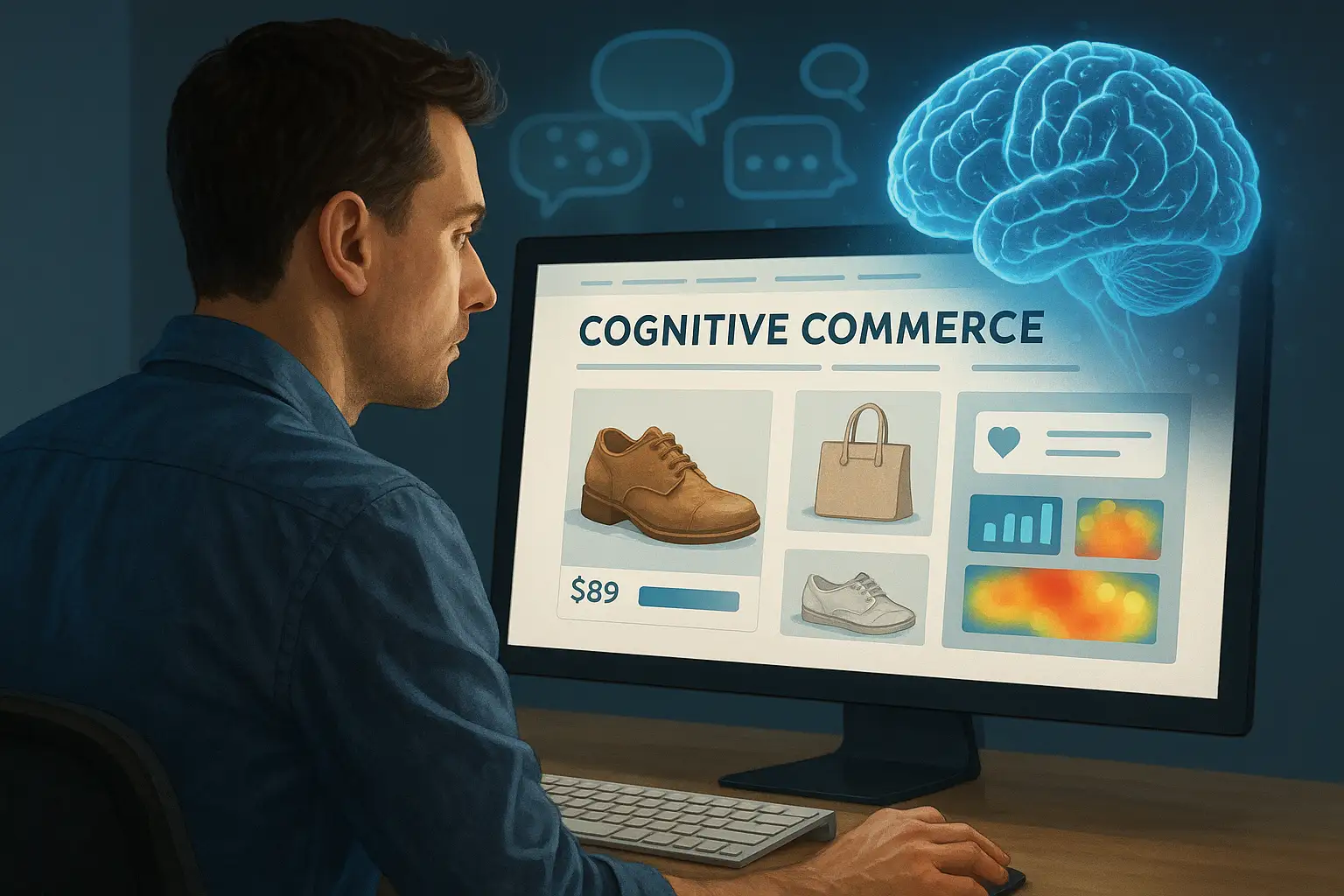
Cognitive Commerce: How AI Learns to Think Like Your Customers and Redefines Digital Shopping
1. Introduction
Traditional e-commerce optimisation is based on tracking visible behaviour — clicks, scrolls, heatmaps, and conversion rates.
But behaviour is only the surface.
Underneath, every customer experiences:
- motivations,
- doubts,
- decision patterns,
- emotional triggers,
- cognitive shortcuts.
For decades, companies could not access this deeper psychological layer.
But AI just changed the rules.
Cognitive Commerce is the evolution of digital retail where AI models don’t just observe what users do — they learn how users think.
2. What Is Cognitive Commerce?
Cognitive Commerce uses AI systems inspired by cognitive science to predict:
- how customers process information,
- what influences their decisions,
- what makes them hesitate,
- what increases trust,
- what creates emotional engagement.
Instead of optimising UI elements manually, AI builds mental models of users and adapts:
- navigation
- product recommendations
- pricing strategies
- content hierarchy
- visual cues
- cognitive load levels
It is the next step after personalization and predictive UX — a deeper, more human-aware approach to digital design.
3. The Science Behind Cognitive Commerce
Cognitive Commerce combines insights from:
A. Cognitive Psychology
How humans perceive, remember, and decide.
B. Behavioral Economics
Biases, heuristics, and mental shortcuts that drive purchases.
C. Machine Learning
Models that detect decision patterns and predict next moves.
D. Neural Simulations
AI systems that simulate the mental flow of users moving through a journey.
E. Sentiment & Emotion Analysis
Tone, pace, hesitation — all decoded by AI.
This fusion allows systems to understand intent before action and motivation beneath behaviour.
4. How Cognitive Commerce Works in Practice
1. AI Detects Cognitive Load
If a user looks overwhelmed (scrolling back and forth, hesitating), the system simplifies the interface instantly.
2. Adaptive Decision Pathways
Each customer gets a different path through the site based on their cognitive style:
analytical, impulsive, hesitant, explorative, or task-focused.
3. Emotion-Aware Commerce
AI senses frustration or confusion and alters messaging and layout.
4. Trust Layer Optimization
If the user seems uncertain, the store shows:
- reviews,
- verified badges,
- guarantees,
- real-life photos.
5. Dynamic Friction Removal
AI removes unnecessary steps automatically when it sees that a user’s cognitive flow is blocked.
5. Use Cases in E-Commerce
A. Product Discovery
AI highlights products that match cognitive preferences, not just browsing behaviour.
B. Pricing Psychology
Different users respond to different pricing structures — cognitive commerce adapts accordingly.
C. Checkout Experience
If a user hesitates before entering payment details, AI simplifies fields or shows reassurance prompts.
D. Onboarding Flows
Apps adjust complexity based on user comfort and pace.
E. Marketplace Navigation
AI reorganizes categories and filters based on the shopper’s decision-making style.
6. Benefits for Businesses
1. Higher Conversions
When a store adapts to how users think, friction disappears.
2. Better Customer Experience
Interfaces feel intuitive and effortless.
3. Stronger Loyalty
Users feel the store “gets them.”
4. Deeper Insights
Businesses understand why users behave as they do — not just what they do.
5. Faster Innovation Cycles
AI continuously learns and redesigns experiences in real time.
7. Challenges & Ethical Considerations
Cognitive Commerce must be deployed responsibly:
- Avoiding manipulation of cognitive biases
- Maintaining transparency in AI decisions
- Protecting sensitive psychological data
- Ensuring user autonomy
- Preventing over-personalisation
Done right — cognitive commerce empowers users instead of exploiting them.
8. The Future of Cognitive Commerce
1. Cognitive Shopping Agents
AI that selects products by understanding user psychology.
2. Emotion-Responsive Interfaces
Layouts shift based on real-time emotional signals.
3. AI-Generated Cognitive Personas
Systems simulate full customer journeys before a feature goes live.
4. Marketplace Intelligence Systems
Platforms self-optimizing based on collective cognitive patterns.
5. Zero-UI Cognitive Purchasing
Commerce without screens, driven by intent and emotional context.
9. Conclusion
Cognitive Commerce is not just another trend — it’s a fundamental shift in how products, websites, and digital systems understand and interact with people.
Instead of designing for an “average” user, companies can now design for every mind, every moment, every intention.
It is the closest digital products have ever come to truly understanding human behaviour — and the companies that adopt this approach will define the next generation of retail and software innovation.
Przeglądaj inne artykuły
Why Most Marketplaces Fail: The Hidden Challenges Behind Scaling Supply and Demand
Composable Marketplaces: Building Flexible, Scalable Platforms for Modern Commerce

The New Marketplace Economy: How Platforms Are Evolving into Intelligent, Scalable Ecosystems

From Search to Intent: How AI Is Rewriting Marketplace Discovery

AI-Driven Marketplaces: Real-Time Offer Matching as a Competitive Advantage

Category Depth vs Category Breadth: The Real Economics Behind Marketplace Expansion

Liquidity Is Not Volume: The Structural Mistake That Kills Marketplaces

The Take Rate Trap: Why Raising Commissions Is the Fastest Way to Kill a Marketplace

When to Fire Sellers: Why the Best Marketplaces Grow Faster by Shrinking Supply

Marketplace Support Costs: The Hidden Margin Killer No One Models

Tiered Pricing Without Backlash: How to Monetize Sellers Without Killing Growth

Seller Segmentation: The Missing System Behind Profitable Marketplaces

Why Most Marketplaces Die at €1–3M GMV (And How to Avoid It)
Marketplace Unit Economics: When Growth Actually Becomes Profitable

How High-Margin Marketplaces Actually Make Money (Beyond Commissions)

Algorithmic Middle Management: How Software Replaces Control Layers

The Rise of Internal Software: Why the Most Profitable Digital Products Are Built for Companies, Not
Decision-Centric Software: Why the Real Value of Digital Products Is Shifting from Features to Decis

Software That Never Launches: Why Continuous Evolution Is Replacing Releases and Roadmaps
Digital Products Without Users: When Software Works Entirely Machine-to-Machine
Unbundled Platforms: Why the Future of Digital Products Belongs to Ecosystems, Not Single Applicatio

Silent Software: Why the Most Valuable Digital Products of the Future Will Be the Ones Users Barely

Predictive UX: How AI Anticipates User Behavior Before It Happens

AI-Driven Product Innovation: How Intelligent Systems Are Transforming the Way Digital Products Are
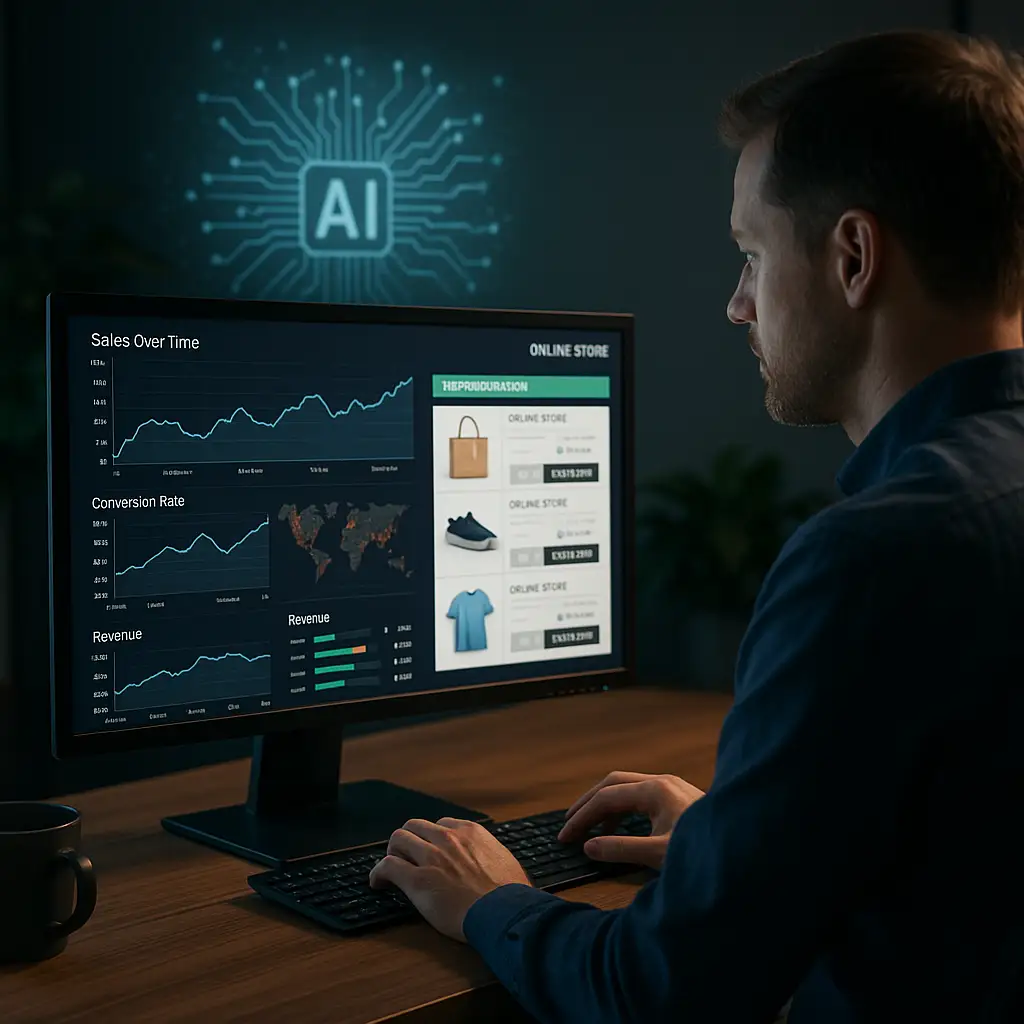
Adaptive Commerce: How AI-Driven Systems Automatically Optimize Online Stores in Real Time

Zero-UI Commerce: How Invisible Interfaces Are Becoming the Future of Online Shopping

AI Merchandising: How Intelligent Algorithms Are Transforming Product Discovery in Modern E-Commerce
Composable Commerce: How Modular Architecture Is Reshaping Modern E-Commerce and Marketplace Develop

Context-Aware Software: How Apps Are Becoming Smarter, Adaptive, and Environment-Responsive
AI-Driven Observability: The New Backbone of Modern Software Systems

Hyper-Personalized Software: How AI Is Creating Products That Adapt Themselves to Every User

Edge Intelligence: The Future of Smart, Decentralized Computing

AI-Powered Cybersecurity: How Intelligent Systems Are Redefining Digital Defense

Modern Software: How Our Company Is Reshaping the Technology Landscape

From Digital Transformation to Digital Maturity: Building the Next Generation of Tech-Driven Busines

AI Agents: The Rise of Autonomous Digital Workers in Business and Software Engineering

Synthetic Data: The Next Frontier of AI and Business Intelligence

Quantum AI: How Quantum Computing Will Redefine Artificial Intelligence and Software Engineering

Design Intelligence: How AI Is Redefining UX/UI and Digital Product Creativity

How Artificial Intelligence Is Transforming DevOps and IT Infrastructure

AI Observability in Production: Monitoring, Anomaly Detection, and Feedback Loops for Smart Applicat

Low-Code Revolution: How Visual Development Is Transforming Software and Marketplace Creation

Composable Marketplaces: How Modular Architecture Is the Future of Platform Engineering
AI-Powered Storyselling: How Artificial Intelligence Is Reinventing Brand Narratives

The Era of Invisible Commerce: How AI Will Make Shopping Disappear by 2030

From Attention to Intention: The New Era of E-Commerce Engagement
Predictive Commerce: How AI Can Anticipate What Your Customers Will Buy Next

Digital Trust 2030: How AI and Cybersecurity Will Redefine Safety in the Digital Age

Cybersecurity in the Age of AI: Protecting Digital Trust in 2025–2030
The Future of Work: Humans and AI as Teammates

Green IT: How the Tech Industry Must Adapt for a Sustainable Future

Emerging Technologies in IT: What Will Shape 2025–2030

Growth Marketing – A Fast-Track Strategy for Modern Businesses

AI SEO Tools – 5 Technologies Revolutionizing Online Stores
AI SEO – How Artificial Intelligence Is Transforming Online Store Optimization

Product-Led Growth – When the Product Sells Itself

Technology in IT – Trends Shaping the Future of Business and Everyday Life

Marketplace Growth – How Exchange Platforms and E-commerce Build the Network Effect

Edge Computing – Bringing Processing Power Closer to the User

Agentic AI in Applications – When Software Starts Acting on Its Own

Neuromorphic Computers and 6G Networks – The Future of IT That Will Change the Game

Meta Llama 3.2 – The Open AI That Could Transform E-Commerce and SEO
AI Chatbot for Online Stores and Apps – More Sales, Better SEO, and Happier Customers

5 steps to a successful software implementation in your company

Innovative IT solutions — why invest now?

Innovative software development methods for your business

5 steps to successfully implement technological innovation in your company