
Decision-Centric Software: Why the Real Value of Digital Products Is Shifting from Features to Decis
Decision-Centric Software: Why the Real Value of Digital Products Is Shifting from Features to Decisions
1. Introduction
For decades, software products competed on features.
More dashboards.
More options.
More configuration.
More control.
Success was measured by how much a user could do inside the system.
But quietly, the center of gravity is shifting.
The most valuable digital products today are not the ones with the most features —
they are the ones that decide.
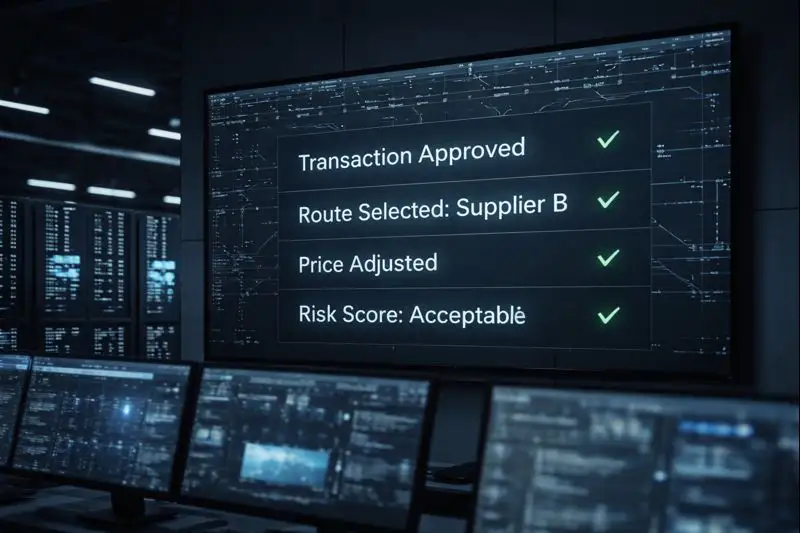
Decide what price to show.
Decide whether a transaction is safe.
Decide which supplier to use.
Decide which user gets priority.
Decide what happens next.
Welcome to the era of decision-centric software.
2. What Is Decision-Centric Software?
Decision-centric software is built around automated decision logic rather than user workflows.
Instead of asking users to analyze data and choose an action, the system:
- evaluates context,
- applies rules and models,
- weighs trade-offs,
- and executes a decision automatically.
Users may observe, override, or audit decisions — but they no longer make them by default.
The product’s value lies in judgment, not interaction.
3. Why Features Are Losing Their Dominance
Feature-driven software assumes:
- humans have time to analyze options,
- decisions are infrequent,
- complexity is manageable.
None of these assumptions hold anymore.
Modern platforms operate in environments that are:
- high-speed,
- high-volume,
- multi-variable,
- real-time.
In such conditions, asking humans to decide becomes a bottleneck — and a risk.
Decisions move to machines not because machines are perfect, but because humans cannot keep up.
4. Where Decision-Centric Software Already Exists
Even if users don’t realize it, decision-centric systems already run critical parts of the economy:
Pricing Engines
Adjust prices dynamically based on demand, supply, and behavior.
Fraud & Risk Systems
Approve or block transactions instantly.
Credit & Eligibility Scoring
Decide who qualifies — and who doesn’t.
Logistics & Routing Systems
Choose optimal paths and suppliers continuously.
Ad & Content Ranking
Determine what gets visibility and what disappears.
These systems don’t support decisions — they are the decision.
5. The Architecture of Decision-Centric Products
Such systems are built differently from classic applications.
A. Decision Models as First-Class Objects
Rules, policies, and ML models are treated as core assets.
B. Separation of Decision and Execution
The system decides first — actions follow automatically.
C. Continuous Feedback Loops
Every decision is evaluated and refined.
D. Explainability Layers
Decisions must be traceable, auditable, and defensible.
E. Governance and Overrides
Human control exists — but as exception handling, not default flow.
This is software as judgment infrastructure.
6. Business Impact: Where the Real Power Lies
Owning decisions means owning outcomes.
Companies that control decision engines can:
- optimize margins invisibly,
- reduce operational cost dramatically,
- enforce policies consistently,
- scale without adding people,
- shape user behavior indirectly.
Decision-centric software often becomes the most strategic layer of a platform — even if it has no UI.
7. Monetization in a Decision-Centric World
These products monetize differently:
- per decision executed,
- per risk prevented,
- per optimization achieved,
- per percentage improvement delivered.
Customers don’t pay for features — they pay for better outcomes.
This often leads to:
- higher margins,
- deeper lock-in,
- lower churn,
- stronger defensibility.
8. Risks and Responsibilities
With decision power comes responsibility.
Key risks include:
- biased decision models,
- lack of transparency,
- regulatory scrutiny,
- loss of human agency,
- ethical concerns.
Decision-centric systems must be designed with:
- clear accountability,
- auditability,
- fairness constraints,
- human escalation paths.
Poorly governed decisions scale harm as efficiently as value.
9. The Future: From Software Tools to Decision Authorities
As AI systems mature, we will see:
- platforms that negotiate autonomously,
- marketplaces that allocate resources dynamically,
- systems that enforce policy without human approval,
- organizations where humans supervise decisions instead of making them.
In this future, software is no longer a tool —
it becomes an authority.
10. Conclusion
The next generation of digital products will not be judged by how many features they offer —
but by how well they decide.
Decision-centric software marks a fundamental shift in where value, power, and responsibility live in digital systems.
The companies that understand this shift early will not just build better products —
they will control the most critical layer of the digital economy: decisions themselves.
Przeglądaj inne artykuły
Why Most Marketplaces Fail: The Hidden Challenges Behind Scaling Supply and Demand
Composable Marketplaces: Building Flexible, Scalable Platforms for Modern Commerce

The New Marketplace Economy: How Platforms Are Evolving into Intelligent, Scalable Ecosystems

From Search to Intent: How AI Is Rewriting Marketplace Discovery

AI-Driven Marketplaces: Real-Time Offer Matching as a Competitive Advantage

Category Depth vs Category Breadth: The Real Economics Behind Marketplace Expansion

Liquidity Is Not Volume: The Structural Mistake That Kills Marketplaces

The Take Rate Trap: Why Raising Commissions Is the Fastest Way to Kill a Marketplace

When to Fire Sellers: Why the Best Marketplaces Grow Faster by Shrinking Supply

Marketplace Support Costs: The Hidden Margin Killer No One Models

Tiered Pricing Without Backlash: How to Monetize Sellers Without Killing Growth

Seller Segmentation: The Missing System Behind Profitable Marketplaces

Why Most Marketplaces Die at €1–3M GMV (And How to Avoid It)
Marketplace Unit Economics: When Growth Actually Becomes Profitable
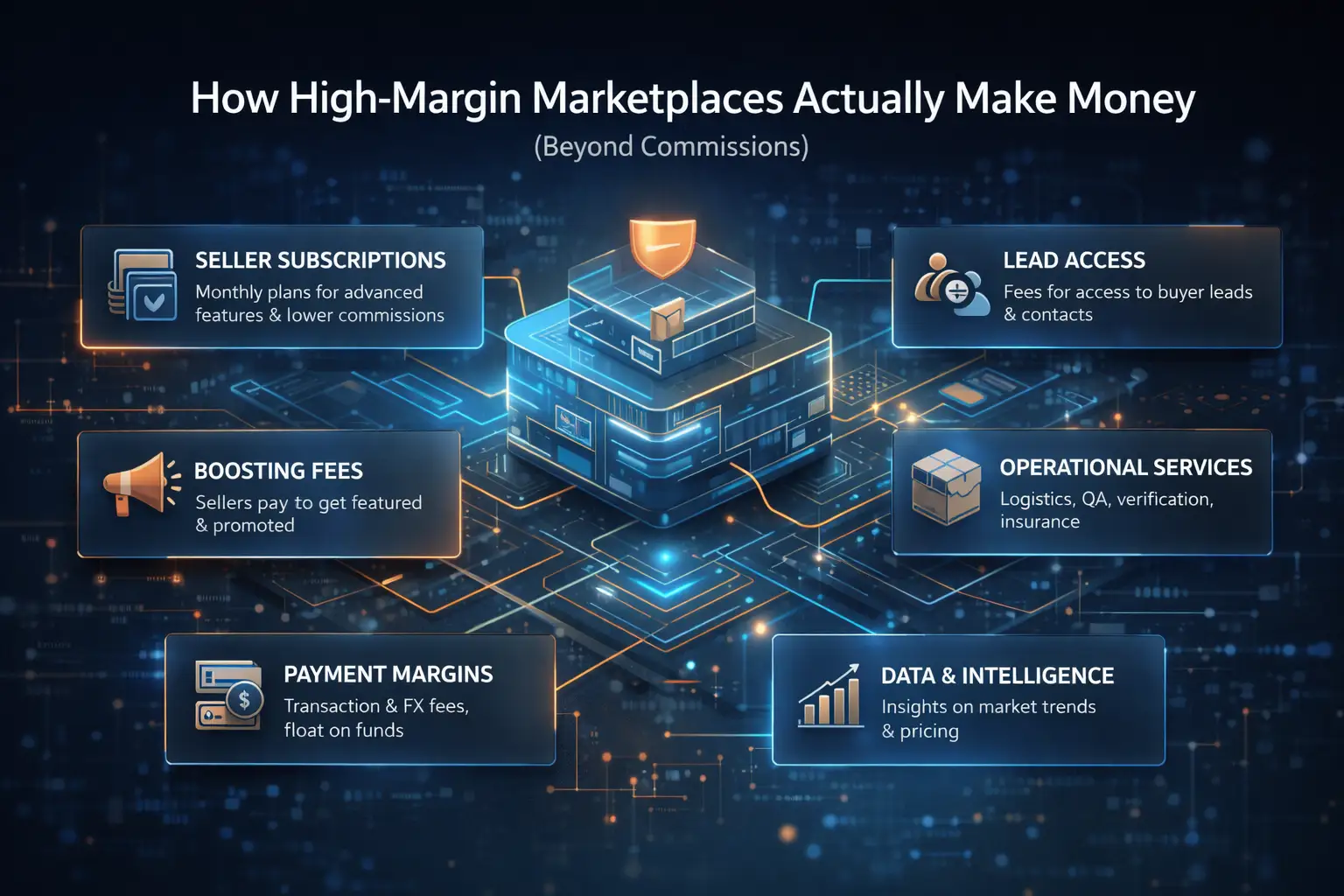
How High-Margin Marketplaces Actually Make Money (Beyond Commissions)

Algorithmic Middle Management: How Software Replaces Control Layers
The Rise of Internal Software: Why the Most Profitable Digital Products Are Built for Companies, Not
Software That Never Launches: Why Continuous Evolution Is Replacing Releases and Roadmaps
Digital Products Without Users: When Software Works Entirely Machine-to-Machine
Unbundled Platforms: Why the Future of Digital Products Belongs to Ecosystems, Not Single Applicatio
Silent Software: Why the Most Valuable Digital Products of the Future Will Be the Ones Users Barely

Cognitive Commerce: How AI Learns to Think Like Your Customers and Redefines Digital Shopping

Predictive UX: How AI Anticipates User Behavior Before It Happens

AI-Driven Product Innovation: How Intelligent Systems Are Transforming the Way Digital Products Are
Adaptive Commerce: How AI-Driven Systems Automatically Optimize Online Stores in Real Time

Zero-UI Commerce: How Invisible Interfaces Are Becoming the Future of Online Shopping

AI Merchandising: How Intelligent Algorithms Are Transforming Product Discovery in Modern E-Commerce
Composable Commerce: How Modular Architecture Is Reshaping Modern E-Commerce and Marketplace Develop

Context-Aware Software: How Apps Are Becoming Smarter, Adaptive, and Environment-Responsive
AI-Driven Observability: The New Backbone of Modern Software Systems

Hyper-Personalized Software: How AI Is Creating Products That Adapt Themselves to Every User

Edge Intelligence: The Future of Smart, Decentralized Computing

AI-Powered Cybersecurity: How Intelligent Systems Are Redefining Digital Defense

Modern Software: How Our Company Is Reshaping the Technology Landscape

From Digital Transformation to Digital Maturity: Building the Next Generation of Tech-Driven Busines

AI Agents: The Rise of Autonomous Digital Workers in Business and Software Engineering

Synthetic Data: The Next Frontier of AI and Business Intelligence

Quantum AI: How Quantum Computing Will Redefine Artificial Intelligence and Software Engineering

Design Intelligence: How AI Is Redefining UX/UI and Digital Product Creativity
How Artificial Intelligence Is Transforming DevOps and IT Infrastructure

AI Observability in Production: Monitoring, Anomaly Detection, and Feedback Loops for Smart Applicat

Low-Code Revolution: How Visual Development Is Transforming Software and Marketplace Creation

Composable Marketplaces: How Modular Architecture Is the Future of Platform Engineering

AI-Powered Storyselling: How Artificial Intelligence Is Reinventing Brand Narratives

The Era of Invisible Commerce: How AI Will Make Shopping Disappear by 2030

From Attention to Intention: The New Era of E-Commerce Engagement
Predictive Commerce: How AI Can Anticipate What Your Customers Will Buy Next

Digital Trust 2030: How AI and Cybersecurity Will Redefine Safety in the Digital Age

Cybersecurity in the Age of AI: Protecting Digital Trust in 2025–2030

The Future of Work: Humans and AI as Teammates

Green IT: How the Tech Industry Must Adapt for a Sustainable Future

Emerging Technologies in IT: What Will Shape 2025–2030

Growth Marketing – A Fast-Track Strategy for Modern Businesses

AI SEO Tools – 5 Technologies Revolutionizing Online Stores
AI SEO – How Artificial Intelligence Is Transforming Online Store Optimization

Product-Led Growth – When the Product Sells Itself

Technology in IT – Trends Shaping the Future of Business and Everyday Life

Marketplace Growth – How Exchange Platforms and E-commerce Build the Network Effect

Edge Computing – Bringing Processing Power Closer to the User

Agentic AI in Applications – When Software Starts Acting on Its Own

Neuromorphic Computers and 6G Networks – The Future of IT That Will Change the Game

Meta Llama 3.2 – The Open AI That Could Transform E-Commerce and SEO

AI Chatbot for Online Stores and Apps – More Sales, Better SEO, and Happier Customers

5 steps to a successful software implementation in your company

Innovative IT solutions — why invest now?

Innovative software development methods for your business

5 steps to successfully implement technological innovation in your company