
Digital Products Without Users: When Software Works Entirely Machine-to-Machine
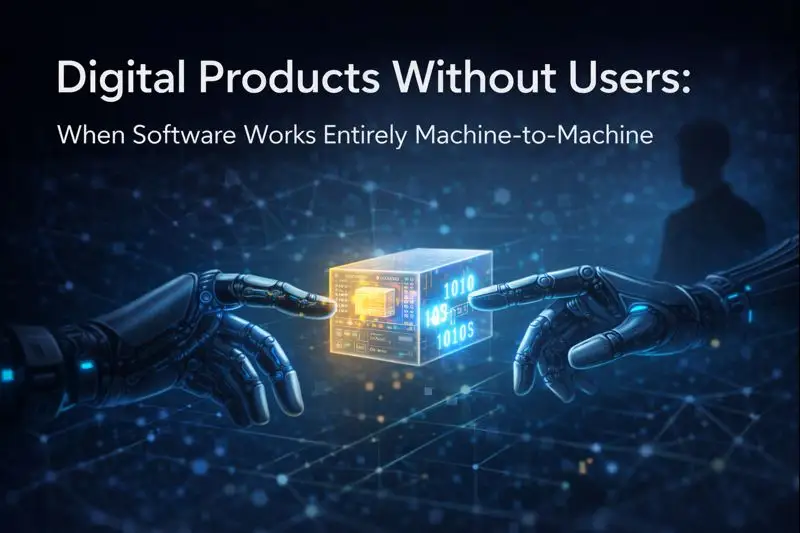
Digital Products Without Users: When Software Works Entirely Machine-to-Machine
1. Introduction
For decades, software design revolved around one central question:
How will users interact with this product?
Interfaces, dashboards, flows, usability, onboarding — everything was optimized for human attention.
But today, an entirely different category of software is taking over critical parts of the digital economy.
These products have no screens.
No buttons.
No onboarding.
No “users” in the traditional sense.
They operate machine-to-machine, silently coordinating data, decisions, and actions at a scale humans could never manage.
Welcome to the era of userless digital products.
2. What Are Digital Products Without Users?
A digital product without users is a system designed to interact exclusively with other systems, not people.
Its consumers are:
- APIs
- services
- agents
- platforms
- algorithms
- devices
Instead of UI, it exposes:
- endpoints
- events
- protocols
- contracts
- automation rules
Value is delivered through execution, not interaction.
Humans may configure or monitor these systems occasionally, but they are not the primary users.
3. Why This Category Is Growing Rapidly
Several structural shifts are driving this trend:
1. Explosion of Platform Complexity
Modern platforms consist of hundreds of interconnected services. Human coordination is no longer viable.
2. Automation at Scale
Manual decision-making cannot keep up with real-time demands.
3. API-First Economies
Products increasingly exist as services, not interfaces.
4. AI Agents Acting Autonomously
Systems now negotiate, route, prioritize, and optimize on their own.
5. Cost and Speed Pressures
Machine-driven systems operate faster and cheaper than human-mediated workflows.
As complexity grows, humans move out of the loop — by necessity, not choice.
4. Real Examples of Userless Software
Even if users never see them, these systems already power daily life:
Payment Routing Engines
Decide in milliseconds how transactions flow between banks, wallets, and processors.
Fraud Detection Systems
Continuously score risk and block suspicious activity — without human review.
Ad Bidding Algorithms
Machines negotiate ad placements with other machines in real time.
Logistics Optimization Engines
Route shipments dynamically based on capacity, weather, and demand.
Recommendation Pipelines
Feed downstream systems personalized outputs without UI exposure.
Infrastructure Orchestration
Auto-scale, deploy, heal, and optimize cloud systems autonomously.
These products don’t feel innovative — because you never interact with them.
But they generate enormous value.
5. How Userless Products Are Designed
Designing software without users requires a different mindset.
A. Interfaces Are Replaced by Contracts
APIs must be precise, stable, and predictable.
B. Reliability Is the UX
Downtime is the worst possible experience — even if no one is watching.
C. Observability Replaces Usability
Logs, metrics, and alerts become the only way to understand behavior.
D. Deterministic Behavior Matters
Systems must act consistently under all conditions.
E. Failures Must Be Graceful
Errors propagate across systems — resilience is critical.
This is product design at an infrastructural level.
6. Business Models for Userless Software
These products monetize differently than traditional apps:
Usage-Based Pricing
Pay per request, event, or transaction.
Throughput-Based Models
Revenue tied to volume or scale.
Outcome-Based Pricing
Charging based on results (fraud prevented, cost reduced).
Platform Dependency
Becoming a critical internal or external dependency.
Embedded Revenue Sharing
Invisible value capture within larger workflows.
Margins are often higher — and churn is lower — than in user-facing products.
7. Why These Products Are Hard to Replace
Once embedded, userless systems become:
- deeply integrated
- operationally critical
- expensive to re-architect
- risky to swap
Switching costs are high, even if the product is invisible.
This creates extraordinary defensibility.
The quietest software often has the strongest lock-in.
8. Risks and Responsibilities
Userless systems also carry serious risks:
- cascading failures
- opaque decision-making
- regulatory scrutiny
- ethical concerns
- systemic bias
- loss of human oversight
When software acts autonomously, accountability becomes harder — and more important.
Designing guardrails, auditability, and intervention mechanisms is essential.
9. The Future: Agent-to-Agent Economies
We are moving toward ecosystems where:
- AI agents negotiate with other agents
- software systems buy, sell, route, and optimize autonomously
- marketplaces operate without direct human input
- decisions happen continuously, not episodically
In this world, products compete on intelligence, reliability, and integration — not design.
Userless software will form the nervous system of the digital economy.
10. Conclusion
The future of digital products is not always visible.
As platforms scale and automation deepens, the most valuable software will be the kind users never interact with — and never even know exists.
These products don’t win by being delightful.
They win by being essential.
For software companies, marketplaces, and infrastructure builders, the opportunity is clear:
The next generation of digital products won’t be designed for people —
they’ll be designed for machines.
Przeglądaj inne artykuły
Why Most Marketplaces Fail: The Hidden Challenges Behind Scaling Supply and Demand
Composable Marketplaces: Building Flexible, Scalable Platforms for Modern Commerce

The New Marketplace Economy: How Platforms Are Evolving into Intelligent, Scalable Ecosystems
From Search to Intent: How AI Is Rewriting Marketplace Discovery
AI-Driven Marketplaces: Real-Time Offer Matching as a Competitive Advantage

Category Depth vs Category Breadth: The Real Economics Behind Marketplace Expansion

Liquidity Is Not Volume: The Structural Mistake That Kills Marketplaces

The Take Rate Trap: Why Raising Commissions Is the Fastest Way to Kill a Marketplace

When to Fire Sellers: Why the Best Marketplaces Grow Faster by Shrinking Supply

Marketplace Support Costs: The Hidden Margin Killer No One Models

Tiered Pricing Without Backlash: How to Monetize Sellers Without Killing Growth
Seller Segmentation: The Missing System Behind Profitable Marketplaces

Why Most Marketplaces Die at €1–3M GMV (And How to Avoid It)
Marketplace Unit Economics: When Growth Actually Becomes Profitable
How High-Margin Marketplaces Actually Make Money (Beyond Commissions)
Algorithmic Middle Management: How Software Replaces Control Layers
The Rise of Internal Software: Why the Most Profitable Digital Products Are Built for Companies, Not
Decision-Centric Software: Why the Real Value of Digital Products Is Shifting from Features to Decis
Software That Never Launches: Why Continuous Evolution Is Replacing Releases and Roadmaps
Unbundled Platforms: Why the Future of Digital Products Belongs to Ecosystems, Not Single Applicatio
Silent Software: Why the Most Valuable Digital Products of the Future Will Be the Ones Users Barely
Cognitive Commerce: How AI Learns to Think Like Your Customers and Redefines Digital Shopping

Predictive UX: How AI Anticipates User Behavior Before It Happens

AI-Driven Product Innovation: How Intelligent Systems Are Transforming the Way Digital Products Are
Adaptive Commerce: How AI-Driven Systems Automatically Optimize Online Stores in Real Time
Zero-UI Commerce: How Invisible Interfaces Are Becoming the Future of Online Shopping

AI Merchandising: How Intelligent Algorithms Are Transforming Product Discovery in Modern E-Commerce
Composable Commerce: How Modular Architecture Is Reshaping Modern E-Commerce and Marketplace Develop

Context-Aware Software: How Apps Are Becoming Smarter, Adaptive, and Environment-Responsive
AI-Driven Observability: The New Backbone of Modern Software Systems

Hyper-Personalized Software: How AI Is Creating Products That Adapt Themselves to Every User
Edge Intelligence: The Future of Smart, Decentralized Computing

AI-Powered Cybersecurity: How Intelligent Systems Are Redefining Digital Defense

Modern Software: How Our Company Is Reshaping the Technology Landscape

From Digital Transformation to Digital Maturity: Building the Next Generation of Tech-Driven Busines
AI Agents: The Rise of Autonomous Digital Workers in Business and Software Engineering
Synthetic Data: The Next Frontier of AI and Business Intelligence

Quantum AI: How Quantum Computing Will Redefine Artificial Intelligence and Software Engineering
Design Intelligence: How AI Is Redefining UX/UI and Digital Product Creativity
How Artificial Intelligence Is Transforming DevOps and IT Infrastructure
AI Observability in Production: Monitoring, Anomaly Detection, and Feedback Loops for Smart Applicat
Low-Code Revolution: How Visual Development Is Transforming Software and Marketplace Creation
Composable Marketplaces: How Modular Architecture Is the Future of Platform Engineering
AI-Powered Storyselling: How Artificial Intelligence Is Reinventing Brand Narratives
The Era of Invisible Commerce: How AI Will Make Shopping Disappear by 2030
From Attention to Intention: The New Era of E-Commerce Engagement
Predictive Commerce: How AI Can Anticipate What Your Customers Will Buy Next

Digital Trust 2030: How AI and Cybersecurity Will Redefine Safety in the Digital Age

Cybersecurity in the Age of AI: Protecting Digital Trust in 2025–2030
The Future of Work: Humans and AI as Teammates
Green IT: How the Tech Industry Must Adapt for a Sustainable Future

Emerging Technologies in IT: What Will Shape 2025–2030

Growth Marketing – A Fast-Track Strategy for Modern Businesses
AI SEO Tools – 5 Technologies Revolutionizing Online Stores
AI SEO – How Artificial Intelligence Is Transforming Online Store Optimization

Product-Led Growth – When the Product Sells Itself
Technology in IT – Trends Shaping the Future of Business and Everyday Life
Marketplace Growth – How Exchange Platforms and E-commerce Build the Network Effect
Edge Computing – Bringing Processing Power Closer to the User

Agentic AI in Applications – When Software Starts Acting on Its Own

Neuromorphic Computers and 6G Networks – The Future of IT That Will Change the Game

Meta Llama 3.2 – The Open AI That Could Transform E-Commerce and SEO
AI Chatbot for Online Stores and Apps – More Sales, Better SEO, and Happier Customers

5 steps to a successful software implementation in your company

Innovative IT solutions — why invest now?

Innovative software development methods for your business

5 steps to successfully implement technological innovation in your company