
Why Most Marketplaces Die at €1–3M GMV (And How to Avoid It)

Why Most Marketplaces Die at €1–3M GMV (And How to Avoid It)
1. The Dangerous “Almost There” Stage
€1M GMV is often celebrated as product–market fit.
€3M GMV feels like validation.
In reality, this range is the most dangerous phase in a marketplace’s life.
Why?
Because:
- the platform is too big to run manually,
- too small to absorb inefficiencies,
- and not yet profitable enough to hire its way out of problems.
Most marketplace failures don’t happen at idea stage.
They happen right here.
2. What Changes at €1–3M GMV (Structurally)
At this stage, several things shift simultaneously:
- seller volume increases rapidly
- support tickets explode
- refunds and disputes appear regularly
- top sellers start negotiating terms
- operational edge cases multiply
- costs scale faster than revenue
What worked at €300k GMV stops working completely.
3. The Margin Compression Trap
What founders expect:
“More volume = more money.”
What actually happens:
- commissions get discounted for top sellers
- payment fees stay fixed
- support cost per order rises
- fraud and refunds increase
- operational complexity grows
Result:
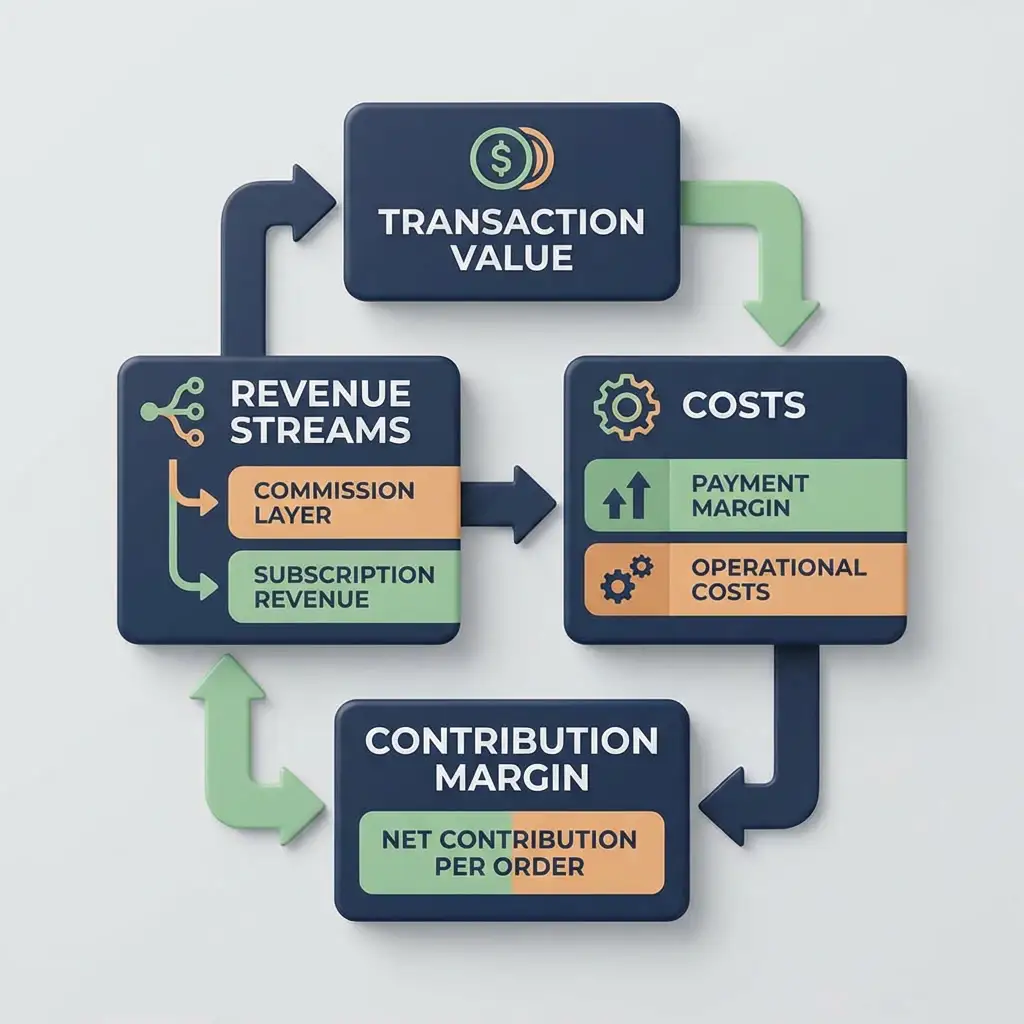
Contribution margin per order drops by 20–40%.
At €1–3M GMV, many marketplaces are less profitable per order than they were earlier.
4. Operations Start Eating the Business
This is where hidden costs surface.
Typical operational issues:
- manual seller onboarding
- human dispute resolution
- custom exceptions for key sellers
- ad-hoc refunds
- spreadsheet-based processes
Each one seems small.
Together, they quietly destroy margins.
If operations scale linearly with GMV, profitability is mathematically impossible.
5. Seller Quality Diverges (And You Ignore It)
At low scale, all sellers look similar.
At €1–3M GMV, they don’t.
You usually have:
- 20% sellers generating 70–80% of GMV
- long-tail sellers creating noise, support load, and churn
Most marketplaces:
- price them the same
- support them the same
- onboard them the same
This is a mistake.
High-margin marketplaces segment sellers aggressively at this stage.
6. The “We’ll Monetize Later” Mistake
Many platforms delay:
- subscriptions
- paid visibility
- data products
- operational services
At €1–3M GMV, it’s often too late.
Sellers are already anchored to:
- low commissions
- free tools
- high expectations
Introducing monetization now causes backlash and churn.
High-performing marketplaces activate secondary revenue streams early, before this stage.
7. The Talent Scaling Illusion
Another common response:
“We’ll just hire more people.”
This usually makes things worse.
Why?
- support scales linearly
- operations remain manual
- costs rise faster than GMV
- complexity increases
Hiring without automation accelerates failure.
At this stage, software must replace people — not the other way around.
8. What Surviving Marketplaces Do Differently
Marketplaces that survive €1–3M GMV usually have:
- Positive unit economics already proven
- Seller segmentation with differentiated pricing
- At least 2 non-commission revenue streams live
- Automated core operations
- Payment control (not externalized)
- Clear data on profitable vs unprofitable sellers
They don’t grow blindly.
They grow selectively.
9. The Survival Checklist (Before You Hit €1M GMV)
If you want to survive this phase, you must have:
- contribution margin tracked per order
- seller LTV vs CAC clearly calculated
- automated onboarding and payouts
- clear rules for disputes and refunds
- subscription or paid seller tiers defined
- visibility into operational cost per transaction
If you don’t have these, pause growth.
Scaling broken economics only makes the collapse faster.
10. Why This Phase Is a Filter — Not a Failure
The €1–3M GMV range is not unlucky.
It is a filter.
It removes:
- marketplaces with weak economics
- platforms built on manual work
- businesses afraid to charge
- teams optimizing growth over structure
The ones that survive emerge stronger, leaner, and more defensible.
11. Conclusion
Most marketplaces don’t die because of competition.
They die because of internal economics and operations.
€1–3M GMV is where reality replaces optimism.
If your marketplace is approaching this stage, the question is not:
“How do we grow faster?”
But:
“Are we structurally ready to survive growth?”
Answer that correctly — and growth finally becomes an asset, not a threat.
Przeglądaj inne artykuły

Why Most Marketplaces Fail: The Hidden Challenges Behind Scaling Supply and Demand

Composable Marketplaces: Building Flexible, Scalable Platforms for Modern Commerce

The New Marketplace Economy: How Platforms Are Evolving into Intelligent, Scalable Ecosystems

From Search to Intent: How AI Is Rewriting Marketplace Discovery

AI-Driven Marketplaces: Real-Time Offer Matching as a Competitive Advantage

Category Depth vs Category Breadth: The Real Economics Behind Marketplace Expansion

Liquidity Is Not Volume: The Structural Mistake That Kills Marketplaces

The Take Rate Trap: Why Raising Commissions Is the Fastest Way to Kill a Marketplace

When to Fire Sellers: Why the Best Marketplaces Grow Faster by Shrinking Supply

Marketplace Support Costs: The Hidden Margin Killer No One Models

Tiered Pricing Without Backlash: How to Monetize Sellers Without Killing Growth

Seller Segmentation: The Missing System Behind Profitable Marketplaces
Marketplace Unit Economics: When Growth Actually Becomes Profitable

How High-Margin Marketplaces Actually Make Money (Beyond Commissions)

Algorithmic Middle Management: How Software Replaces Control Layers

The Rise of Internal Software: Why the Most Profitable Digital Products Are Built for Companies, Not

Decision-Centric Software: Why the Real Value of Digital Products Is Shifting from Features to Decis

Software That Never Launches: Why Continuous Evolution Is Replacing Releases and Roadmaps

Digital Products Without Users: When Software Works Entirely Machine-to-Machine

Unbundled Platforms: Why the Future of Digital Products Belongs to Ecosystems, Not Single Applicatio

Silent Software: Why the Most Valuable Digital Products of the Future Will Be the Ones Users Barely

Cognitive Commerce: How AI Learns to Think Like Your Customers and Redefines Digital Shopping

Predictive UX: How AI Anticipates User Behavior Before It Happens

AI-Driven Product Innovation: How Intelligent Systems Are Transforming the Way Digital Products Are

Adaptive Commerce: How AI-Driven Systems Automatically Optimize Online Stores in Real Time

Zero-UI Commerce: How Invisible Interfaces Are Becoming the Future of Online Shopping

AI Merchandising: How Intelligent Algorithms Are Transforming Product Discovery in Modern E-Commerce

Composable Commerce: How Modular Architecture Is Reshaping Modern E-Commerce and Marketplace Develop

Context-Aware Software: How Apps Are Becoming Smarter, Adaptive, and Environment-Responsive

AI-Driven Observability: The New Backbone of Modern Software Systems

Hyper-Personalized Software: How AI Is Creating Products That Adapt Themselves to Every User

Edge Intelligence: The Future of Smart, Decentralized Computing

AI-Powered Cybersecurity: How Intelligent Systems Are Redefining Digital Defense

Modern Software: How Our Company Is Reshaping the Technology Landscape

From Digital Transformation to Digital Maturity: Building the Next Generation of Tech-Driven Busines

AI Agents: The Rise of Autonomous Digital Workers in Business and Software Engineering

Synthetic Data: The Next Frontier of AI and Business Intelligence

Quantum AI: How Quantum Computing Will Redefine Artificial Intelligence and Software Engineering

Design Intelligence: How AI Is Redefining UX/UI and Digital Product Creativity

How Artificial Intelligence Is Transforming DevOps and IT Infrastructure

AI Observability in Production: Monitoring, Anomaly Detection, and Feedback Loops for Smart Applicat

Low-Code Revolution: How Visual Development Is Transforming Software and Marketplace Creation

Composable Marketplaces: How Modular Architecture Is the Future of Platform Engineering

AI-Powered Storyselling: How Artificial Intelligence Is Reinventing Brand Narratives

The Era of Invisible Commerce: How AI Will Make Shopping Disappear by 2030

From Attention to Intention: The New Era of E-Commerce Engagement

Predictive Commerce: How AI Can Anticipate What Your Customers Will Buy Next

Digital Trust 2030: How AI and Cybersecurity Will Redefine Safety in the Digital Age

Cybersecurity in the Age of AI: Protecting Digital Trust in 2025–2030

The Future of Work: Humans and AI as Teammates

Green IT: How the Tech Industry Must Adapt for a Sustainable Future

Emerging Technologies in IT: What Will Shape 2025–2030

Growth Marketing – A Fast-Track Strategy for Modern Businesses

AI SEO Tools – 5 Technologies Revolutionizing Online Stores
AI SEO – How Artificial Intelligence Is Transforming Online Store Optimization

Product-Led Growth – When the Product Sells Itself

Technology in IT – Trends Shaping the Future of Business and Everyday Life

Marketplace Growth – How Exchange Platforms and E-commerce Build the Network Effect

Edge Computing – Bringing Processing Power Closer to the User

Agentic AI in Applications – When Software Starts Acting on Its Own

Neuromorphic Computers and 6G Networks – The Future of IT That Will Change the Game

Meta Llama 3.2 – The Open AI That Could Transform E-Commerce and SEO

AI Chatbot for Online Stores and Apps – More Sales, Better SEO, and Happier Customers

5 steps to a successful software implementation in your company

Innovative IT solutions — why invest now?

Innovative software development methods for your business

5 steps to successfully implement technological innovation in your company